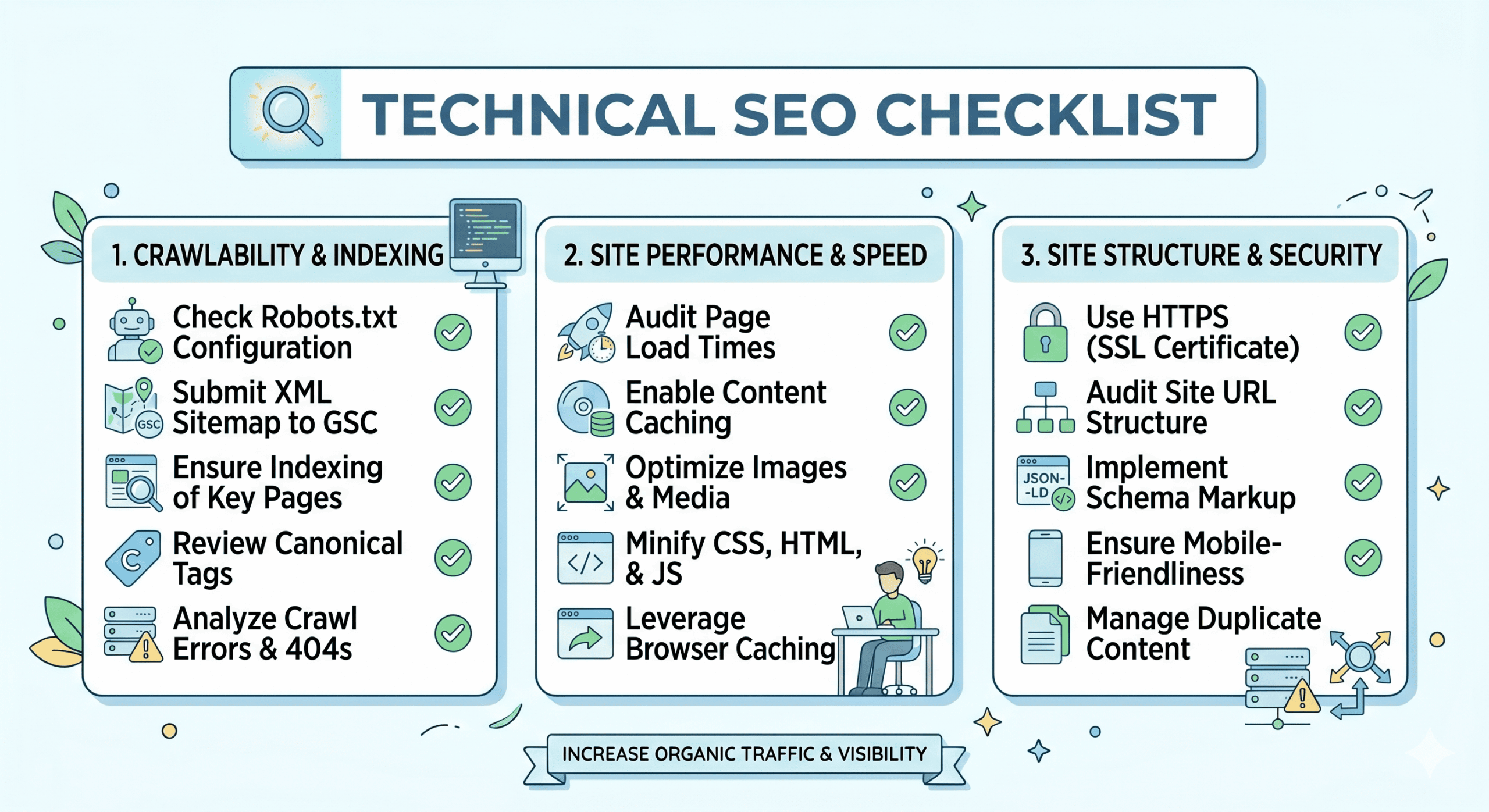
Technical SEO Checklist
Table of Contents
Navigating the complexities of search engine algorithms can feel like a maze, but your journey toward higher rankings starts with a solid foundation. This technical seo checklist is designed for web developers, site owners, and digital marketers who need to ensure their website is crawlable, indexable, and performant. Even the best content in the world will fail to rank if search engines cannot access it or if the user experience is hampered by slow speeds and broken links. By following this guide, you solve the fundamental problem of visibility and ensure that your technical infrastructure supports your organic growth goals.
Technical SEO is often viewed as a daunting task reserved for “code-wizards,” but it is actually a logical series of checks and optimizations. When your site is technically sound, you are essentially rolling out the red carpet for search engine bots. This article breaks down the process into actionable stages, allowing you to audit your site systematically without getting overwhelmed by the sheer volume of data.
Preparation Stage: Setting Up Your Technical SEO Checklist
Before you begin tweaking code or changing server settings, you must have the right tools and access in place. This stage is about gathering the data necessary to make informed decisions. Without a baseline, you cannot measure the success of your optimizations.
- ✅ Gain full administrative access to Google Search Console and Bing Webmaster Tools.
- ✅ Install and configure a reliable SEO crawling tool like Screaming Frog, Ahrefs, or Semrush.
- ✅ Ensure you have access to your website’s hosting control panel and FTP/SFTP.
- ✅ Verify that Google Analytics (or a similar privacy-focused alternative) is tracking data correctly across all pages.
- ✅ Conduct a baseline crawl to identify current errors for your technical seo checklist documentation.
- ✅ Create a backup of your website’s current state, including the database and core files, before making any changes.
Planning Stage: Building a Sustainable Technical SEO Checklist Strategy
A well-organized website structure is the backbone of successful SEO. In this stage, you focus on the logic and hierarchy of your site. Search engines prefer sites that are easy to navigate and have a clear relationship between different pages. Planning helps you avoid “cannibalization” and ensures that your crawl budget is spent on your most important pages.
- ✅ Map out a flat site architecture where any page can be reached within three clicks from the homepage.
- ✅ Review and standardize your URL structure; use descriptive, hyphenated slugs and avoid dynamic parameters where possible.
- ✅ Identify and document the primary “hub” pages and how “spoke” pages will link back to them to build topical authority.
- ✅ Planning Stage Check: Ensure your technical seo checklist includes a review of your XML sitemap to confirm it only contains URLs you want indexed.
- ✅ Determine which sections of the site should be hidden from search engines using the Robots.txt file.
- ✅ Audit your internal linking strategy to ensure link equity is flowing to high-priority landing pages.
Creation Stage: Executing Core Technical Elements
This is where the heavy lifting happens. The execution phase focuses on the fundamental protocols that tell search engines how to interact with your site. Security, accessibility, and crawl directives are the pillars of this stage. Implementing these correctly ensures that your site is viewed as trustworthy and professional by both Google and its users.
- ✅ Force HTTPS globally to ensure a secure connection for all users and satisfy Google’s security ranking factor.
- ✅ Optimize your Robots.txt file to guide crawlers away from sensitive or redundant areas like login pages or admin panels.
- ✅ Implement “Canonical” tags on every page to prevent duplicate content issues, especially for e-commerce sites with product variations.
- ✅ Fix all 404 “Not Found” errors by redirecting them to the most relevant live page using 301 permanent redirects.
- ✅ Eliminate redirect chains and loops that frustrate users and exhaust crawl budgets.
- ✅ Ensure the site is fully responsive and provides an excellent experience on mobile devices, adhering to mobile-first indexing.
Publishing or Execution Stage: Performance and Enhanced Indexing
Once the basic protocols are in place, you must focus on speed and how your content is presented in search results. Modern SEO is heavily influenced by “Core Web Vitals,” which measure page loading performance, interactivity, and visual stability. This stage of the technical seo checklist ensures your site isn’t just “readable” but also fast and visually engaging.
- ✅ Optimize Largest Contentful Paint (LCP) by compressing large images and utilizing a Content Delivery Network (CDN).
- ✅ Improve First Input Delay (FID) or Interaction to Next Paint (INP) by reducing JavaScript execution time.
- ✅ Minimize Cumulative Layout Shift (CLS) by specifying dimensions for images and video elements in your code.
- ✅ Implement Structured Data (Schema Markup) to help search engines understand the context of your content and earn rich snippets.
- ✅ Optimize images using modern formats like WebP and ensuring each image has descriptive alt text.
- ✅ Enable browser caching and Gzip compression at the server level to reduce file transfer sizes.
Promotion and Follow-up Stage: Maintenance and Monitoring
Technical SEO is not a “set it and forget it” task. As you add content and update your site, new issues will inevitably arise. This stage is dedicated to long-term health monitoring and ensuring that your previous efforts continue to yield results. Regular maintenance prevents small glitches from turning into ranking disasters.
- ✅ Set up weekly or monthly automated crawls to catch new 404 errors or broken images before they affect rankings.
- ✅ Monitor the “Indexing” report in Google Search Console to identify pages that are “Crawled – currently not indexed.”
- ✅ Regularly check for broken external links (outbound links) that could lead to a poor user experience.
- ✅ Audit your sitemap regularly to ensure newly published pages are being added and old, redirected pages are removed.
- ✅ Review server log files to see exactly how search engine bots are interacting with your site.
- ✅ Keep an eye on your site speed metrics, as plugin updates or new scripts can often slow down your performance.
Pro Tips for Advanced Optimization
Once you have mastered the basics of the technical seo checklist, you can implement advanced tactics to stay ahead of the competition. These tips are for those looking to squeeze every bit of performance out of their web assets.
- Log File Analysis: Use tools to analyze server logs. This reveals if Googlebot is wasting time on low-value pages, allowing you to refine your crawl budget management.
- Dynamic Rendering: If you use heavy JavaScript frameworks like React or Vue, consider dynamic rendering to ensure bots see a fully rendered HTML version of your site.
- Hreflang for Global Sites: If you serve multiple languages, use hreflang tags meticulously to ensure the correct version of your site appears in the local search results.
- Pagination Handling: Avoid “infinite scroll” without a fallback; use paginated sets or “Load More” buttons that are crawlable to ensure bots find all your archived content.
- HTTP/3 Implementation: Talk to your hosting provider about enabling HTTP/3 to further reduce latency and improve the speed of connection handshakes.
Conclusion
Completing a technical seo checklist is one of the most rewarding investments you can make in your digital strategy. By focusing on crawlability, speed, and site structure, you create a seamless bridge between your content and the search engines that index it. Remember that technical SEO is the foundation upon which all your other marketing efforts sit. Without it, your keywords and backlinks won’t reach their full potential. Start with the preparation stage today, audit your current performance, and systematically work through these items to give