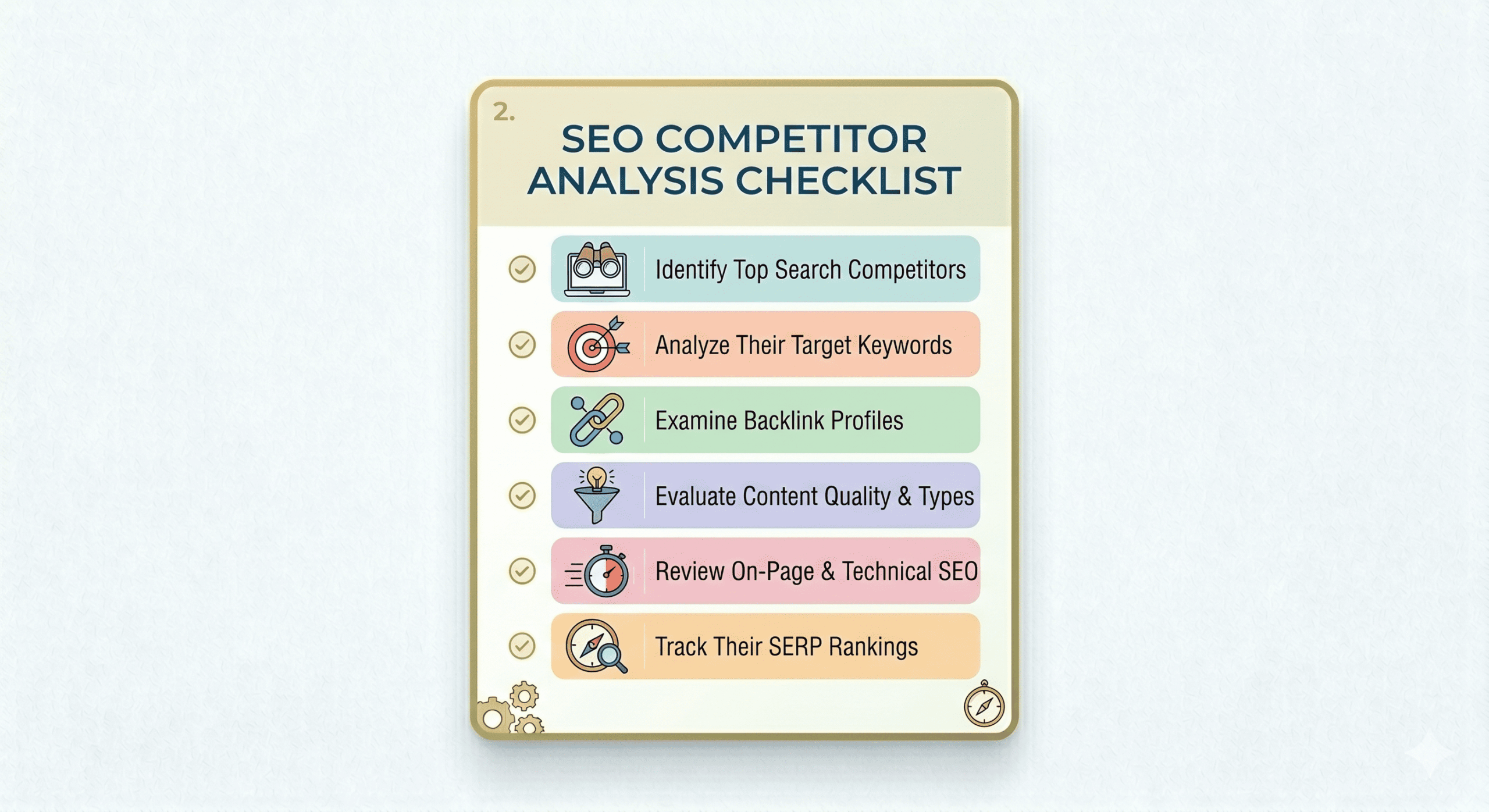
SEO Competitor Analysis Checklist
Table of Contents
In the competitive world of digital marketing, success isn’t just about what you do; it’s about how you measure up against everyone else in the search results. If you have ever felt like your content is shouting into a void while your competitors seem to effortlessly glide to the top of Google, you are not alone. Many businesses struggle because they focus solely on their own site without looking at the roadmap their rivals have already built. This is where a comprehensive seo competitor analysis checklist becomes your most valuable asset. This guide is designed for marketers, SEO specialists, and business owners who need to bridge the gap between “good” content and “ranking” content by dissecting the strategies of those already winning.
Preparation Stage
Before you start crunching numbers or pulling backlink reports, you need to set the stage. Jumping into analysis without a clear framework usually leads to data overload and very little action. The preparation phase is about defining who you are fighting against and what tools you will use to win. Remember, your competitors online might be different from your competitors in the physical world.
- ✅ Identify your top 3-5 direct business competitors (those who sell what you sell).
- ✅ Identify your top 3-5 search competitors (informational sites or blogs that outrank you for keywords).
- ✅ List the primary products, services, or topics you want to prioritize for this seo competitor analysis checklist.
- ✅ Select your SEO toolkit (common choices include Ahrefs, SEMrush, Moz, or Screaming Frog).
- ✅ Create a centralized spreadsheet to document your findings and keep your data organized.
Planning Stage: The SEO Competitor Analysis Checklist
Strategic planning allows you to look at the “big picture” of the search landscape. This is where you identify the high-level metrics that dictate who Google trusts. By comparing your site’s overall authority against your rivals, you can determine if you need to focus more on technical authority or content depth. A solid plan ensures you aren’t chasing keywords that are realistically out of your reach due to authority gaps.
- ✅ Benchmark your Domain Authority (DA) or Domain Rating (DR) against each competitor.
- ✅ Map out the site architecture of the top-ranking competitors to see how they group their content.
- ✅ Perform a “Keyword Gap” analysis to find high-volume terms your rivals rank for that you haven’t targeted yet.
- ✅ Analyze the historical traffic trends of your competitors to see if they are growing or losing visibility.
- ✅ Document which pages are driving the most organic traffic to their sites to identify their “money pages.”
Creation Stage
The creation stage is where you get into the weeds of the content itself. You aren’t just looking at what they wrote; you are looking at how they wrote it and how it is structured. To beat a competitor, you must provide more value, better clarity, or a better user experience. This part of the seo competitor analysis checklist helps you deconstruct the “secret sauce” of high-ranking pages so you can replicate and improve upon their success.
- ✅ Audit the top-performing content for your target keywords to determine average word count and depth.
- ✅ Identify the types of media being used, such as custom graphics, videos, or interactive calculators.
- ✅ Evaluate the readability and tone of voice that seems to resonate with your shared audience.
- ✅ Inspect the “On-Page” elements: Are they using specific keywords in H1, H2, and H3 tags that you missed?
- ✅ Note the presence of internal linking patterns—how are they passing “link juice” to their important pages?
Publishing or Execution Stage
Once you have the data, you must turn it into a physical strategy. This stage involves taking the insights from your seo competitor analysis checklist and applying them to your own website. It’s the bridge between research and reality. You will focus on closing the technical and content gaps you discovered during your investigation to ensure your site is a formidable opponent in the eyes of search engines.
- ✅ Update existing content that is underperforming compared to competitor versions.
- ✅ Create new landing pages or blog posts for the “gap keywords” identified in the planning stage.
- ✅ Optimize your meta titles and descriptions to be more “clickable” than the current top-ranking results.
- ✅ Implement schema markup (Structured Data) if you notice competitors are winning rich snippets.
- ✅ Ensure your page load speed and mobile usability are superior to the average competitor’s metrics.
Promotion and Follow-up Stage
The work doesn’t end when you hit “publish.” In fact, promotion is often what separates the top three results from the rest of the first page. Monitoring your progress and staying agile is key. Competitors will likely notice your movements and react, so your seo competitor analysis checklist must be a living document that you revisit regularly to maintain your edge.
- ✅ Analyze the backlink sources of your competitors and reach out to the same high-authority sites.
- ✅ Monitor your keyword rankings weekly to see how your changes are impacting