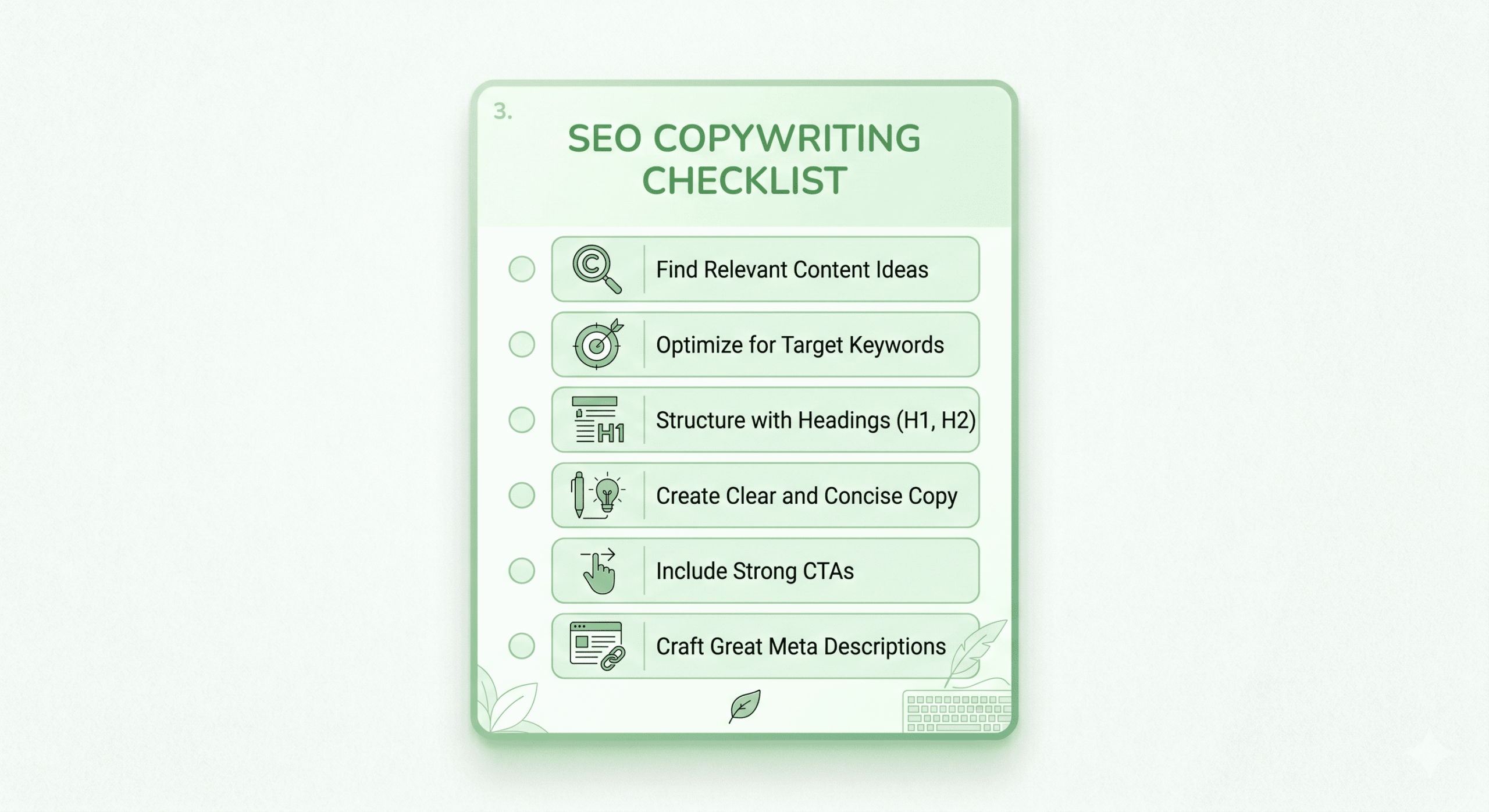
SEO Copywriting Checklist
Table of Contents
Writing content that ranks on the first page of Google while simultaneously converting readers into customers is a delicate balancing act. Many creators struggle because they either write solely for search engines, resulting in robotic and unappealing text, or they write only for humans, missing out on the technical signals that trigger higher rankings. This seo copywriting checklist is designed for digital marketers, freelance writers, and business owners who need a repeatable framework to produce high-performance content. By following these steps, you will solve the problem of low organic traffic and high bounce rates, ensuring every word you publish serves a strategic purpose.
Preparation Stage for Your SEO Copywriting Checklist
Before you type a single sentence, you must lay the groundwork. Success in search engine optimization is 80% research and 20% execution. Skipping this stage usually leads to content that misses the mark on user intent, regardless of how well it is written.
- ✅ Identify the primary search intent (Informational, Navigational, Transactional, or Commercial) to ensure your tone matches the user’s goal.
- ✅ Select one primary focus keyword with a healthy balance of search volume and attainable difficulty.
- ✅ Research 3–5 semantic (LSI) keywords that provide context to your main topic.
- ✅ Analyze the top three ranking results on Google to see what they are doing well and where they are failing.
- ✅ Define your “Unique Value Proposition” for the piece—what will you say that hasn’t been said a thousand times before?
Planning Stage
A solid structure prevents “writer’s block” and ensures your content remains focused. Search engines love well-organized data, and users love content that is easy to scan. Planning your document helps you visualize the flow of information before you get bogged down in the details.
- ✅ Create a working title that includes your focus keyword near the beginning.
- ✅ Outline your H2 and H3 subheadings to create a logical hierarchy that guides the reader.
- ✅ Map out where your internal links will go, identifying existing pages on your site that provide additional value.
- ✅ Determine the ideal word count by averaging the length of the top-performing competitors.
- ✅ Prepare a brief list of external, high-authority sources you plan to cite to build credibility.
Creation Stage
This is where the magic happens. Your goal is to write naturally while weaving in the technical elements that search engines look for. Remember, your primary audience is a human being with a problem to solve, not a crawler looking for a keyword density percentage.
- ✅ Write a “hook” in the first paragraph that addresses the reader’s pain point and mentions the primary keyword.
- ✅ Use short sentences and paragraphs (no more than 3–4 lines) to improve mobile readability.
- ✅ Cross-reference your draft against this seo copywriting checklist to ensure you are hitting your semantic keyword targets naturally.
- ✅ Incorporate “Bucket Brigades”—short, conversational phrases like “Here is the best part” or “Think about it”—to keep readers moving down the page.
- ✅ Use active voice rather than passive voice to maintain a sense of energy and authority.
- ✅ Ensure your Call to Action (CTA) is clear, visible, and directly related to the content’s purpose.
Finalizing the Content with Your SEO Copywriting Checklist
Once the draft is complete, the focus shifts to technical optimization and “polishing.” This stage ensures that search engine crawlers can easily index your content and that users have a seamless experience across all devices, particularly on mobile where the majority of searches occur.
- ✅ Optimize your Meta Title and Meta Description to encourage high click-through rates (CTR).
- ✅ Rewrite your URL slug to be short, descriptive, and keyword-rich (e.g., /seo-copywriting-checklist/).
- ✅ Add descriptive Alt Text to all images, ensuring they are accessible and relevant to the surrounding text.
- ✅ Check for broken links—both internal and external—using a tool like “Check My Links.”
- ✅ Run a final readability check using a tool like Hemingway or Grammarly to eliminate unnecessary jargon.
- ✅ Verify that your H1 tag is unique and not duplicated in any of your subheadings.
Promotion and Follow-up Stage
Publishing the content is only half the battle. To truly succeed, you must signal to the internet that your content is valuable and worth visiting. Ongoing maintenance and promotion ensure that your hard work doesn’t stagnate on the second or third page of search results.
- ✅ Share the article across your primary social media channels (LinkedIn, X, Facebook) with custom captions.
- ✅ Send a dedicated email blast to your newsletter subscribers with a link to the new post.
- ✅ Reach out to influencers or websites you mentioned in the article to let them know they’ve been featured.
- ✅ Monitor the page’s performance in Google Search Console after 30 days to see which queries are driving traffic.
- ✅ Schedule a “content refresh” for 6–12 months from now to update statistics and keep the information current.
Pro Tips
If you want to take your content from “good” to “unstoppable,” consider these advanced strategies that many professional copywriters use to dominate the SERPs.
- Focus on E-E-A-T: (Experience, Expertise, Authoritativeness, and Trustworthiness). Include an author bio that highlights why you are qualified to write on the topic.
- Use Schema Markup: Implementing FAQ or How-To schema can help your content take up more “real estate” in the search results