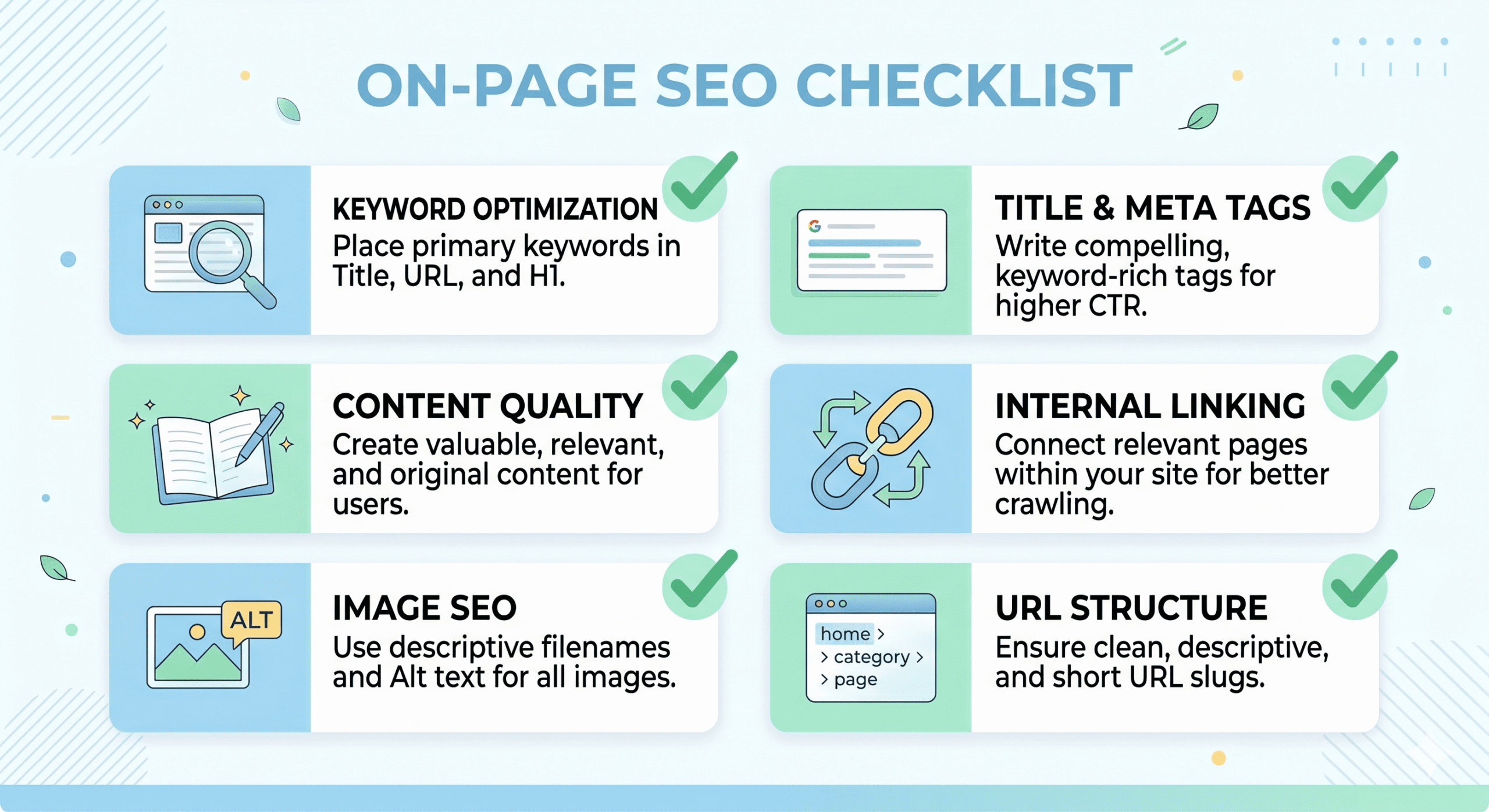
On Page SEO Checklist
Table of Contents
Search engine optimization can often feel like a moving target, but the most controllable aspect of your digital presence is what happens directly on your website. Whether you are a small business owner, a marketing manager, or a freelance blogger, following a structured on page seo checklist is the most effective way to ensure your content is visible to both users and search engine crawlers.
This guide is designed to solve the problem of “invisible content”—those well-written articles that simply never find their way to the first page of Google. By systematically checking off these boxes, you turn your website into a high-performance machine that speaks the language of search algorithms while providing genuine value to human readers.
Preparation Stage
Before you type a single word of content, you need to set the stage. Success in SEO is 20% execution and 80% preparation. You wouldn’t build a house without a blueprint, and you shouldn’t build a webpage without the right data and tools in place.
- ✅ Define your primary target keyword and at least 3-5 secondary/semantic variations.
- ✅ Set up and verify your site on Google Search Console to monitor performance.
- ✅ Install an SEO plugin (like Yoast or RankMath) to help manage technical meta-data.
- ✅ Audit your competitors’ top-ranking pages to see what content depth and tone they are using.
- ✅ Confirm that the page you are about to create aligns with a specific business goal (leads, sales, or awareness).
Your Essential On Page SEO Checklist for Planning
Planning involves matching your content to what users are actually looking for. Search intent is the “why” behind a query. If you provide a shopping guide when the user wants a tutorial, your page will never rank, regardless of how many keywords you use. This stage ensures your on page seo checklist is grounded in user psychology.
- ✅ Identify the Search Intent: Is the user looking to buy (transactional), learn (informational), or find a specific site (navigational)?
- ✅ Map your focus keyword to a specific URL to avoid “keyword cannibalization” where your own pages compete against each other.
- ✅ Outline your heading structure (H1, H2, H3) to ensure a logical flow of information.
- ✅ Determine the ideal content length by analyzing the average word count of the top 5 results for your keyword.
- ✅ Choose a clean, descriptive URL slug that includes your focus keyword and avoids unnecessary numbers or dates.
Creation Stage
This is where the magic happens. When you are writing and building your page, you must balance readability with algorithmic optimization. High-quality content should feel natural to the reader while giving “clues” to search engines about the page’s topic. This is a critical step in any on page seo checklist because content remains the strongest ranking factor in the modern SEO era.
- ✅ Write a compelling H1 title that includes your focus keyword and grabs the reader’s attention.
- ✅ Ensure your focus keyword appears in the first 100 words of the introduction.
- ✅ Use the focus keyword naturally throughout the text, maintaining a density of roughly 0.5% to 1.5%.
- ✅ Incorporate LSI (Latent Semantic Indexing) keywords—terms related to your topic—to help Google understand the context.
- ✅ Optimize your images by using descriptive file names and adding keyword-rich Alt Text for accessibility.
- ✅ Use bullet points, numbered lists, and short paragraphs to improve the “skimmability” of the page.
- ✅ Include at least 2-3 internal links to other relevant pages on your website to distribute “link equity.”
- ✅ Add external links to high-authority, reputable sources to build trust with your readers.
The Comprehensive On Page SEO Checklist for Technical Execution
Once the content is written, you need to package it for the web. Technical on-page SEO ensures that search engine bots can crawl your page efficiently and that the user experience is seamless across all devices. If your page takes ten seconds to load, it doesn’t matter how good the writing is; people will leave before they see it.
- ✅ On page seo checklist requirement: Audit your Title Tag to ensure it is under 60 characters and contains your focus keyword.
- ✅ Craft a unique Meta Description (under 155 characters) that acts as an “ad” for your page in search results.
- ✅ Check your page on a mobile device to ensure all elements are responsive and easy to tap.
- ✅ Compress all images using a tool like TinyPNG to ensure fast loading speeds.
- ✅ Implement Schema Markup (Structured Data) to help your page appear as a rich snippet in search results.
- ✅ Ensure your page is served over HTTPS for security and user trust.
- ✅ Verify that there are no “broken links” (404 errors) within your content.
Promotion and Follow-up Stage
SEO is not a “set it and forget it” task. Once you hit publish, you need to signal to the world that your content exists. This stage focuses on driving initial traffic and maintaining the health of your page over time so that your rankings continue to climb.
- ✅ Manually submit your new URL to Google Search Console for faster indexing.
- ✅ Share the page across your social media channels to generate initial engagement signals.
- ✅ Repurpose the content into an email newsletter for your existing subscribers.
- ✅ Monitor your rankings and click-through rates (CTR) after 30 days to identify areas for improvement.
- ✅ Update the content at least once a year to keep the information fresh and relevant.
Pro Tips
To truly dominate the search results, you need to go beyond the basics. These advanced tips will help you outshine competitors who are only doing the bare minimum.
- Focus on Core Web Vitals: Google now prioritizes pages that offer a stable, fast visual experience. Use the PageSpeed Insights tool to identify specific “Cumulative Layout Shift” issues.
- Optimize for “Featured Snippets”: Look for the “People Also Ask” section in Google and answer those specific questions directly in your content using a Q&A format.
- The “First Link Priority” Rule: If you link to the same page twice from one article, Google usually only counts the anchor text of the first link. Make sure your first internal link uses the most descriptive keyword.
- Semantic Entity Optimization: Instead of just keywords, focus on “entities” (specific people, places, or things). Linking to a Wikipedia page for a complex term can help Google categorize your content more accurately.
Conclusion
Navigating the world of search engines doesn’t have to be a guessing game. By following this on page seo checklist, you have a repeatable framework that ensures every piece of content you produce is optimized for maximum visibility and engagement. Remember, SEO is a marathon, not a sprint. While these changes may take a few weeks to show results, the cumulative effect of having a technically sound and user-focused website is invaluable for long-term growth.
Now is the time to take action. Pick one page on your site today that isn’t performing as well as you’d like, and run it through these checklist stages. You’ll likely find several small tweaks that can lead to a significant jump in your search rankings. Ready to climb the SERPs? Start optimizing now!