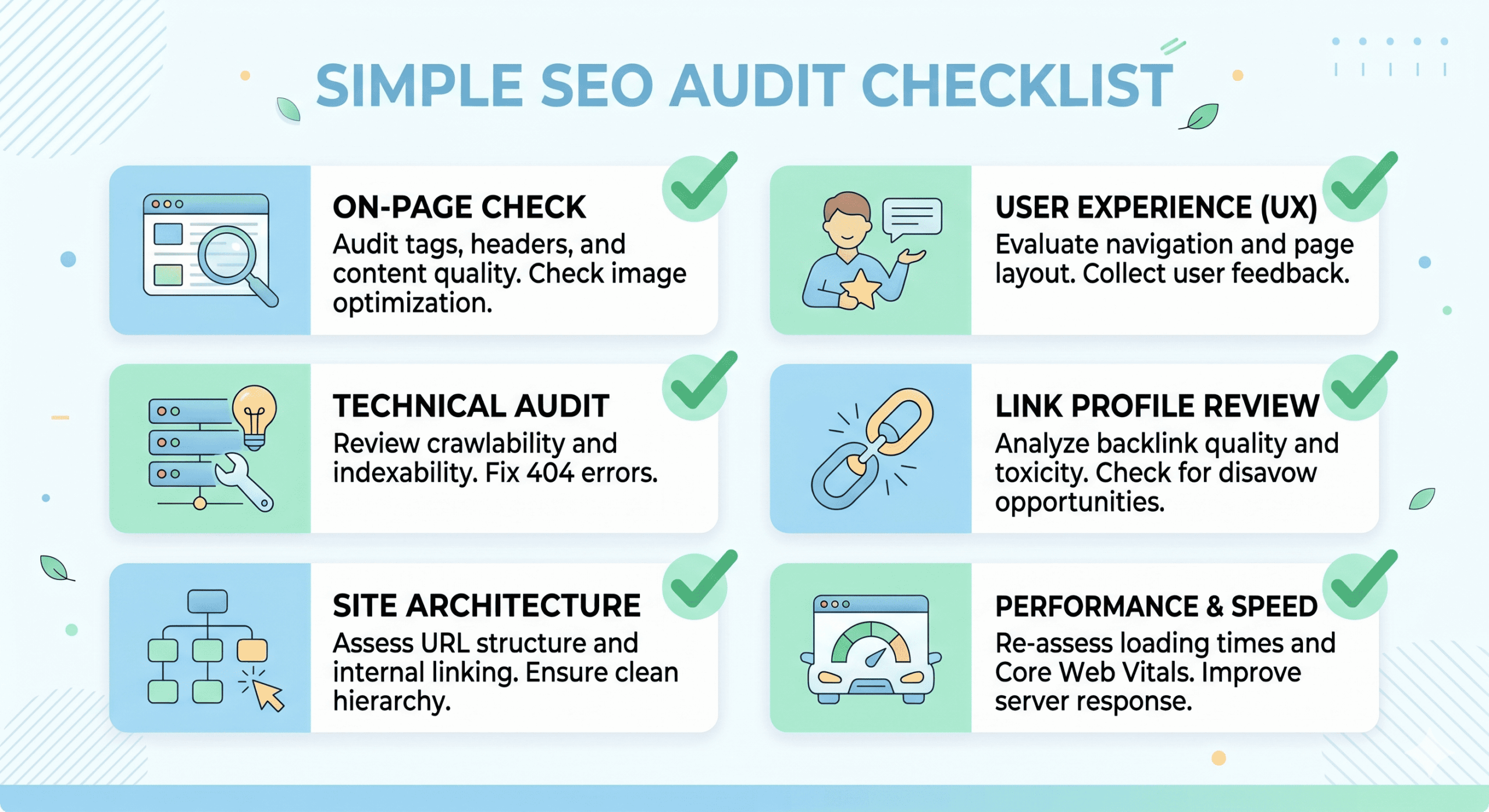
SEO Audit Checklist
Table of Contents
Maintaining a high-ranking website requires more than just occasional content updates; it demands a deep structural health check to ensure you are meeting search engine requirements. This seo audit checklist is designed for digital marketers, business owners, and SEO professionals who need a clear roadmap to identify why their organic traffic has stalled or how to reach the next level of visibility. By systematically reviewing your site’s technical foundation and on-page elements, you can solve common problems like indexing issues, poor mobile performance, and declining keyword rankings.
Preparation Stage for Your SEO Audit Checklist
Before you dive into the technicalities, you need the right environment and data sources. An audit is only as good as the information you feed it, so gathering your toolkit is the first essential step.
- ✅Verify Google Search Console (GSC) access: Ensure your property is correctly verified to see real-time indexing data and manual actions.
- ✅Set up Google Analytics 4 (GA4): Confirm that tracking codes are firing correctly across all pages to measure traffic fluctuations.
- ✅Select a crawling tool: Use software like Screaming Frog, Ahrefs, or Semrush to simulate how a search engine bot views your site.
- ✅ Connect your API keys: If using advanced tools, connect GSC and PageSpeed Insights APIs to your crawler for integrated data.
- ✅ Define your audit scope: Decide if you are auditing the entire domain, a specific subfolder, or a newly launched section of the site.
Planning Stage
Success in search optimization comes from strategy, not just random fixes. In this stage, you define your benchmarks and prioritize the areas that will yield the highest return on investment.
- ✅Perform a competitor gap analysis: Identify which keywords your competitors rank for that you are currently missing.
- ✅Review historical traffic data: Look for significant drops in the last 12 months to pinpoint when potential issues began.
- ✅ Identify “Low-Hanging Fruit”: Target pages that are currently ranking on the second page (positions 11-20) for immediate optimization.
- ✅Establish a ranking baseline: Document your current positions for your primary focus keywords to measure post-audit progress.
- ✅Audit your backlink profile: Use a link analysis tool to identify toxic links or lost high-authority backlinks that need reclaiming.
Creation and Technical Analysis Stage
This is the core of the process where you get your hands dirty with the data. You will look at both the “under the hood” technical aspects and the “on the page” content elements. Following a structured seo audit checklist ensures no stone is left unturned during this deep dive.
- ✅Check Indexability and Crawlability: Ensure your robots.txt file isn’t accidentally blocking important pages and that your sitemap is up to date.
- ✅Analyze Core Web Vitals: Review Largest Contentful Paint (LCP), First Input Delay (FID), and Cumulative Layout Shift (CLS) scores.
- ✅Evaluate URL Structure: Ensure URLs are descriptive, lowercase, and use hyphens rather than underscores or random strings of numbers.
- ✅ Audit Title Tags and Meta Descriptions: Look for duplicate titles, missing descriptions, or snippets that are too long and getting truncated.
- ✅Inspect Heading Hierarchy: Confirm each page has exactly one H1 tag and that H2 through H6 tags follow a logical, nested order.
- ✅Verify Image Optimization: Check for large file sizes that slow down pages and ensure every image has descriptive alt text.
- ✅Assess Internal Linking: Look for “orphan pages” that have no internal links pointing to them and ensure your most important pages have the most internal authority.
- ✅Mobile-Friendliness Check: Use Google’s mobile-friendly testing tools to ensure your site is responsive and easy to navigate on smartphones.
Execution and Implementation Stage
Once you have identified the errors, it is time to deploy the fixes. This stage transforms your findings into a functional, optimized website that search engines will favor.
- ✅ Fix 404 Errors and Broken Links: Set up 301 redirects for any broken URLs to preserve link equity and improve user experience.
- ✅Update the XML Sitemap: After cleaning up your URLs, generate a new sitemap and resubmit it via Google Search Console.
- ✅Minify CSS, JavaScript, and HTML: Reduce code bloat to improve your site’s overall loading speed and performance.
- ✅ Implement Schema Markup: Add structured data (like Article, Product, or FAQ schema) to help search engines understand your content better.
- ✅Resolve Content Cannibalization: Identify pages targeting the same keywords and either merge them or use canonical tags to show the preferred version.
- ✅Improve Content Depth: Update thin content pages with more expert insights, better data, and clearer answers to user intent.
Promotion and Follow-up Stage
An audit doesn’t end when the fixes are live. You must monitor the impact of your changes and ensure your site continues to grow in authority through external signals.
- ✅Monitor Search Console for Errors: Keep a close eye on the “Indexing” report to ensure your fixes are being recognized by Google.
- ✅Request Re-indexing: For high-priority pages you’ve recently fixed, use the URL Inspection tool in GSC to ask Google to crawl them immediately.
- ✅ Track Keyword Movements: Use a rank tracker to see if your optimized pages are climbing the Search Engine Results Pages (SERPs).
- ✅Promote Updated Content: Share your newly optimized “power pages” on social media or through email newsletters to drive initial traffic.
- ✅Analyze User Behavior: Check your bounce rate and dwell time in GA4 to see if the improvements actually satisfied your visitors.
- ✅ Schedule the next audit: SEO is not a one-time event; set a calendar reminder to revisit this seo audit checklist every six months.
Pro Tips for Advanced Optimization
Take your website performance to the next level with these expert-level strategies that go beyond basic maintenance.
- Prune your content: Don’t be afraid to delete or “noindex” low-quality pages that provide no value. This concentrates “crawl budget” on your best performing assets.
- Analyze Search Intent: Sometimes a page doesn’t rank because the content type doesn’t match what users want. If the top 10 results are videos, your long-form blog post might struggle regardless of SEO.
- Audit for “E-E-A-T”: Ensure your site has clear author bios, an “About Us” page, and visible contact information to build trust with both users and algorithms.
- Check for “Zombie Pages”: These are pages that get zero traffic and have no links. They weigh your site down. Either improve them, redirect them, or remove them.
- Optimize for Featured Snippets: Look for opportunities to provide concise, bulleted answers to common questions to jump to “Position Zero.”
Conclusion
Completing a comprehensive seo audit checklist is the most effective way to ensure your website remains competitive in an ever-changing digital landscape. By addressing everything from technical crawlability to content depth and user experience, you create a foundation that search engines love to reward.
Remember that SEO is a marathon, not a sprint; the changes you implement today may take weeks or even months to fully manifest in your rankings, but the long-term growth is worth the effort.
Don’t let technical debt or outdated content hold your business back. Start by running your first crawl today, prioritizing your most critical errors, and systematically working through this list. If you want to dominate your niche, consistency is key. Download or bookmark this guide and make it a core part of your digital marketing routine!