SEO Checklist
Table of Contents
Navigating the complexities of digital marketing can often feel like trying to solve a puzzle with moving pieces, but having a comprehensive seo checklist is your reliable compass for finding your way to the top of search engine results. Search engine optimization is not a one-time event; it is a continuous process of refinement, monitoring, and adaptation.
Whether you are launching a brand-new website or revitalizing an existing one, the foundational steps you take today will dictate your organic visibility for months and years to come. In this guide, we will break down the essential elements of a modern strategy, moving from technical foundations to high-level content creation.
The Foundation: Technical SEO and Initial Setup
Before you start writing catchy headlines or building backlinks, you must ensure that your website’s infrastructure is sound. Search engines like Google need to be able to find, crawl, and index your content without hitting any roadblocks. The first step in any seo checklist should be the integration of tracking tools. Google Search Console and Google Analytics are non-negotiable.
Search Console provides direct feedback from the search engine regarding your site’s health, showing you which pages are indexed and which keywords are driving impressions. Meanwhile, Google Analytics allows you to understand user behavior once they arrive on your site.
A critical part of this foundation is the XML sitemap. Think of this as a roadmap for search engines. By submitting your sitemap to search engines, you are explicitly telling them which pages are important and when they were last updated. Furthermore, you must verify your robots.txt file.
This small text file instructs bots on which parts of your site they should avoid. If misconfigured, you could accidentally hide your most important pages from the world. Ensuring that your site uses HTTPS is another vital technical checkmark. Security is a ranking factor, and a “Not Secure” warning in a browser will kill your conversion rates instantly.
Mastering Keyword Research and Intent
Keyword research is the heartbeat of your optimization strategy. It is not just about finding words with high search volume; it is about understanding the intent behind the query. When a user types something into a search bar, are they looking to buy, to learn, or simply to find a specific website? To build an effective seo checklist, you must categorize your keywords into informational, navigational, commercial, and transactional categories. This allows you to tailor your content specifically to what the user expects to find.
Use tools like Ahrefs, Semrush, or even the free Google Keyword Planner to identify long-tail keywords. These are longer, more specific phrases that often have lower competition but much higher conversion rates. For example, instead of targeting “shoes,” you might target “best running shoes for flat feet.”
Once you have your list of target terms, look at the current top-ranking pages for those terms. What are they doing right? Is the content a listicle, a long-form guide, or a product page? Your goal is to create something that provides more value than the current top results.
The On-Page SEO Checklist for Higher Rankings
On-page optimization refers to the elements you can control directly on your website. Every page you publish should be treated as an individual opportunity to rank for specific terms. When people ask what to include in an seo checklist for content, the following elements are paramount:
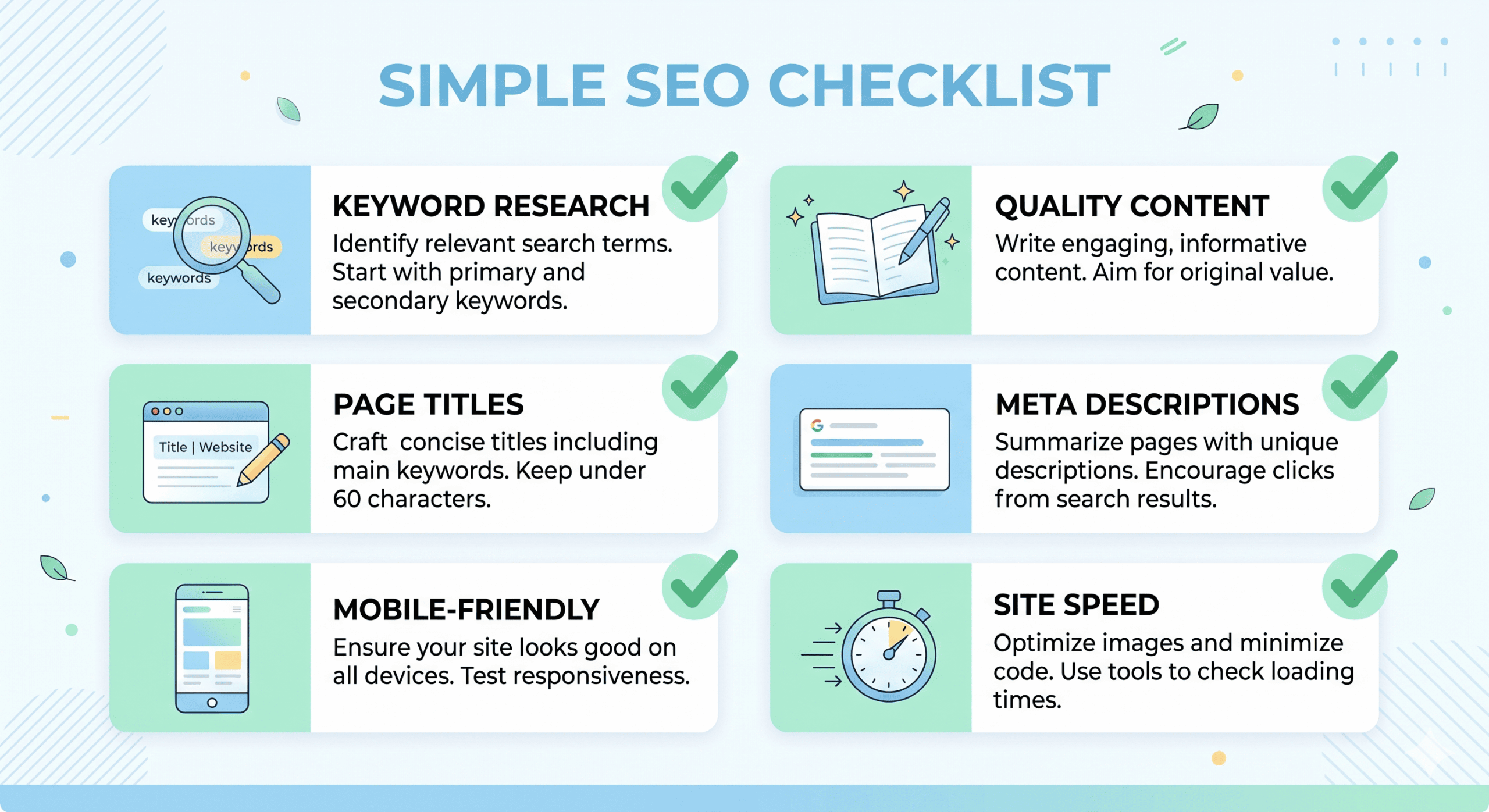
- Title Tags: Ensure your focus keyword is near the beginning of the title. Keep it under 60 characters to avoid truncation in search results.
- Meta Descriptions: While not a direct ranking factor, a compelling meta description increases your click-through rate (CTR), which signals relevance to search engines.
- Header Tags (H1, H2, H3): Use headers to structure your content. The H1 should be unique to each page and include your primary keyword, while H2s and H3s should use semantic variations.
- URL Structure: Keep URLs short, descriptive, and keyword-rich. Avoid generic strings of numbers or dates.
- Image Alt Text: Describe your images for accessibility and search bots. This also helps your images appear in Google Image Search.
- Internal Linking: Link to other relevant pages on your site to distribute “link equity” and help users navigate your content.
- Follow a consistent seo checklist: Regularly reviewing these on-page elements ensures that no page falls behind as your site grows.
Content quality is the most significant on-page factor. Google’s E-E-A-T (Experience, Expertise, Authoritativeness, and Trustworthiness) guidelines are essential. You need to demonstrate that you are a credible source.
This means citing statistics, writing in a clear and professional tone, and providing unique insights that cannot be found elsewhere. Avoid keyword stuffing at all costs. Instead, focus on “Latent Semantic Indexing” (LSI) keywords—terms that are naturally related to your main topic.
Technical Performance and Core Web Vitals
In recent years, user experience (UX) has become inextricably linked with search rankings. Google’s Core Web Vitals are a set of metrics that measure page load speed, interactivity, and visual stability. If your site takes more than three seconds to load, you are likely losing a significant portion of your mobile audience. Use tools like PageSpeed Insights to identify what is slowing you down. Often, the culprits are oversized images, unoptimized JavaScript, or slow server response times.
Mobile-friendliness is no longer optional. With mobile-first indexing, Google primarily uses the mobile version of your content for indexing and ranking. Test your site on various devices to ensure that buttons are easy to click, text is legible without zooming, and there are no intrusive pop-ups that block the main content. A site that is difficult to use on a smartphone will never reach its full potential in organic search, regardless of how good the content is.
Off-Page SEO: Building Authority and Trust
Off-page optimization is primarily about building the reputation of your website. The most important factor here is backlinks—links from other websites to yours. Think of a backlink as a vote of confidence. However, not all votes are equal.
A single link from a high-authority, relevant site like the New York Times or an industry-leading blog is worth more than a thousand links from low-quality, spammy directories. Focus on “earned” links through high-quality guest posting, PR outreach, and creating “linkable assets” like original research, infographics, or comprehensive guides.
Social signals and brand mentions also play a role. While social media links are usually “no-follow” (meaning they don’t pass direct ranking power), the traffic and visibility they generate can lead to more organic backlinks.
Engaging in community forums, appearing on podcasts, and maintaining active social profiles help establish your brand as an authority in your niche. Consistency is key here; a sudden spike in links followed by months of silence can look suspicious to search engine algorithms.
Content Maintenance and Performance Tracking
An often overlooked part of the seo checklist is the audit and maintenance phase. The digital world moves fast, and content can become outdated quickly. A “content decay” analysis can help you identify pages that used to perform well but are now losing traffic.
Updating these pages with fresh statistics, new images, and updated information can often result in a quick ranking boost. This is much more efficient than always trying to create new content from scratch.
Monitoring your performance requires looking beyond just rankings. Track your organic traffic, bounce rate, and conversion rate. If you are ranking number one for a keyword but nobody is clicking, your title tag or meta description likely needs work.
If people are clicking but leaving immediately, your content might not be meeting their intent. Use the data gathered from your analytics tools to make informed decisions rather than relying on guesswork. Search engine optimization is a marathon, not a sprint, and data is your best friend during the journey.
The Ultimate SEO Checklist Summary
To ensure you haven’t missed any critical steps, here is a consolidated list of tasks to perform regularly. These points summarize the most impactful actions you can take to improve your digital presence:
- Set up essential tools: Install Google Analytics and Search Console immediately.
- Perform a technical audit: Check for crawl errors, broken links, and duplicate content.
- Optimize for mobile: Ensure your site is fully responsive and fast on all devices.
- Keyword research: Identify high-intent terms and map them to specific pages.
- On-page optimization: Refine titles, headers, and meta data for every post.
- Improve internal linking: Connect your content to help users and bots find related topics.
- Secure your site: Use HTTPS and maintain a clean robots.txt file.
- Build quality backlinks: Focus on relevance and authority over sheer quantity.
- Update old content: Refresh declining pages to maintain their search positions.
- Include this seo checklist in your workflow: Make these steps a standard part of every new page launch.
By following this structured approach, you remove the mystery from search engine optimization. It becomes less about “tricking” an algorithm and more about providing the best possible experience for the user.
When search engines see that users are satisfied with your content, they will naturally reward you with higher visibility. It requires patience and a commitment to quality, but the long-term rewards of consistent organic traffic are well worth the effort.
Ultimately, the goal of any seo checklist is to create a website that serves both the search engine and the human visitor. As algorithms become more sophisticated, they are increasingly better at identifying content that truly helps people.
Focus on clarity, speed, and value. Keep an eye on the technical health of your site, but never lose sight of the fact that you are writing for people. If you consistently provide answers to the questions your audience is asking, your site will not only survive algorithm updates but will thrive in an increasingly competitive digital marketplace.