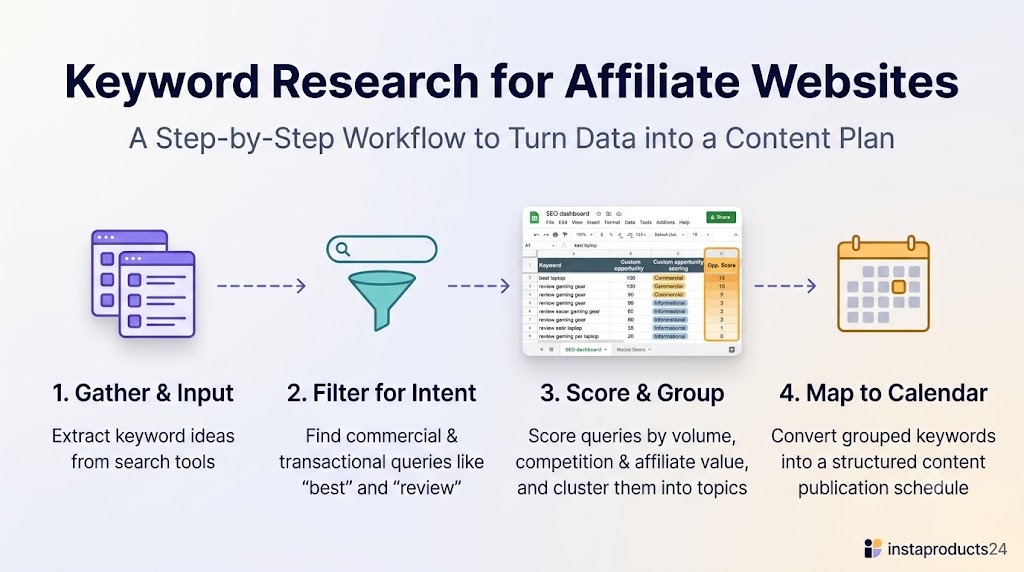
Keyword Research for Affiliate Websites: Find Better Topics
Keyword research for affiliate websites helps you find the questions people ask before choosing a product or service, and decide which of those questions your site can answer credibly. Affiliate SEO is not just about targeting phrases such as “best product” or “product review.” Helpful sites also explain problems, compare options fairly, clarify limitations, and guide readers toward a suitable decision. The goal is to serve the reader first and make affiliate recommendations only when they are relevant.
Understand the affiliate search journey
Affiliate audiences may move through several stages. Early-stage readers learn about a problem; mid-stage readers compare approaches or product categories; late-stage readers evaluate specific products, prices, features, and alternatives. These stages are not always linear. One visitor may be researching a problem while another is ready to purchase, so your content plan should include different kinds of useful answers.
Types of affiliate keywords
Informational keywords include “how to improve home Wi-Fi” or “how to choose a standing desk.” Commercial investigation queries include “best standing desk for a small room” or “Brand A vs Brand B.” Review queries focus on a specific product, while transactional searches may include “buy,” “price,” “discount,” or a retailer name. These are clues, not fixed rules; inspect current results to confirm the dominant need.
Step 1: Define your niche and audience
Choose a niche where you can understand the audience, evaluate options responsibly, and produce useful content. Define who the reader is, what they need, what constraints matter, and which products you can assess. A broad niche such as technology may be too large to cover well at first. A focused audience—such as home-office workers choosing equipment for small spaces—can give your research clearer boundaries.
Step 2: Generate keyword ideas
Collect ideas from product categories, customer reviews, support questions, forums, comparison searches, search suggestions, competitor content, and keyword tools. Record the exact wording where possible and note what problem the query suggests. For product-focused topics, include attributes such as budget, size, compatibility, skill level, use case, durability, and maintenance when they matter to the buying decision.
Step 3: Classify search intent and commercial value
Label each keyword as informational, navigational, commercial investigation, or transactional. Then assess how closely it fits your audience and whether an affiliate recommendation would genuinely help. A query about repairing an item may not need a product roundup; a query comparing models probably does. Do not force commercial links into every article. Trust is easier to maintain when recommendations match the reader’s actual need.
Step 4: Assess competition realistically
Keyword difficulty scores can help you sort a large list, but inspect the search results before deciding. Look at the quality and depth of competing pages, whether they demonstrate real product knowledge, and what important questions remain unanswered. Consider your site’s topical focus and resources. A specific query may offer an opportunity, but “low competition” does not mean easy traffic or guaranteed sales.
Step 5: Plan the right content type
A tutorial can help readers understand a problem; a category guide can explain what to look for; a comparison can evaluate two or more products; a review can examine a specific product; and a roundup can compare several options for a defined use case. The page should be based on real evaluation and clear selection criteria. If you have not tested a product, do not imply first-hand testing. State what information your assessment uses and what remains unknown.
Step 6: Build fair, useful product content
Explain who each option suits, who should avoid it, the important trade-offs, and how the products differ. Use current specifications from reliable sources and first-hand testing only when actually performed. Disclose affiliate relationships clearly and follow applicable advertising rules. Do not make unsupported performance claims, fabricate personal experiences, or rank products only by commission. A useful recommendation helps the reader decide even if the best choice is not the most profitable one.
Step 7: Organize keywords into clusters
Group related queries by the same user need. A cluster around “best ergonomic chair for a small desk” might include budget, size, adjustability, and comparison queries. Decide whether those terms belong on one comprehensive page or on separate pages with distinct intent. Map each cluster to a target URL and review existing pages before creating new content. This helps reduce duplication and clarify the site structure.
Step 8: Prioritize opportunities
Score each topic based on audience fit, demand, ranking potential, product relevance, and effort. Consider whether the content can be genuinely useful with the information and resources available. A highly commercial keyword may be attractive, but it can also be competitive and require credible product evaluation. A practical informational article may help build trust and support internal links to a comparison page later.
Measure beyond rankings
Track impressions, clicks, and query performance in Search Console. If you have appropriate analytics and affiliate reporting, review outbound clicks and conversions as well. Separate traffic from business outcomes: a page can attract visitors without helping them choose, and a lower-traffic page can be useful if it answers a specific decision question. Use the data to improve content rather than adding affiliate links indiscriminately.
Conclusion
Effective affiliate keyword research starts with a defined audience, identifies queries across the decision journey, validates intent, evaluates competition, groups related terms, and maps them to genuinely useful pages. Be transparent about affiliate relationships and the evidence behind recommendations. SEO Keyword Research OS from instaproducts24 is designed to help organize keyword inputs, search intent, priority scores, clusters, and content planning in Google Sheets. It can support the workflow, but product evaluation, editorial judgment, and honest disclosures remain your responsibility.
Frequently asked questions
What are buyer-intent keywords?
They are queries that suggest a person is evaluating or preparing to choose a product or service. Phrases like “best,” “review,” “versus,” and “price” can be clues.
Should affiliate sites only target commercial keywords?
No. Informational content can answer early-stage questions, build trust, and support relevant links to comparison pages.
How do I find low-competition affiliate keywords?
Use keyword tools as a starting point, inspect current results, evaluate your site’s relevance, and look for specific audience needs that competing pages do not address well.
Do I need to test every product I review?
Do not imply first-hand testing if it did not happen. Explain the basis of your evaluation, use reliable evidence, and disclose limitations.
How should I disclose affiliate links?
Use a clear disclosure where readers can notice it, and follow the rules that apply to your market and affiliate program.
Can keyword research guarantee affiliate sales?
No. Sales depend on many factors, including audience fit, trust, product availability, content quality, site experience, and the offer itself.
One thought on “Keyword Research for Affiliate Websites: Find Better Topics”