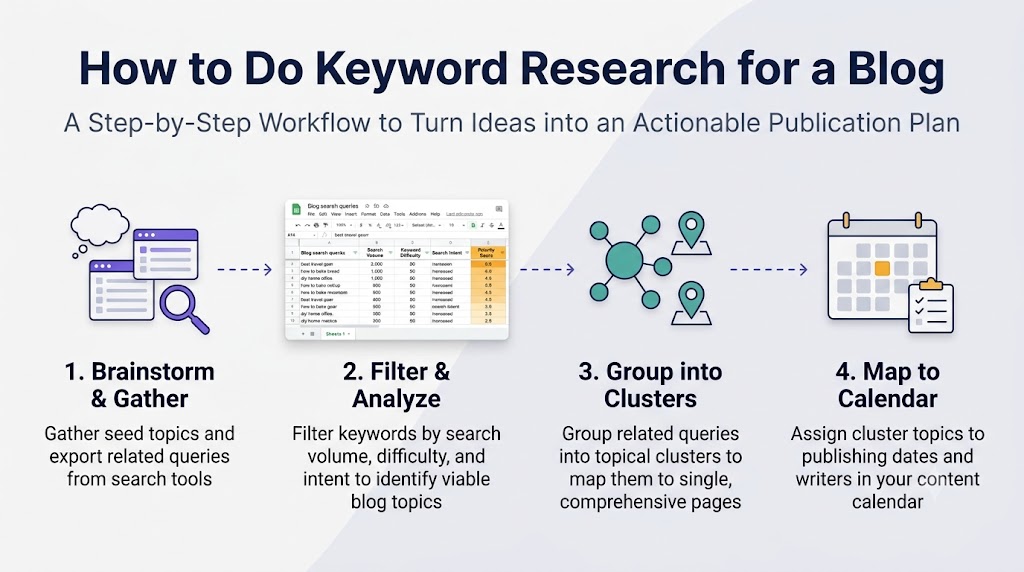
How to Do Keyword Research for a Blog: A Beginner’s Guide
Learning how to do keyword research for a blog helps you choose topics people are already searching for instead of publishing posts based only on guesses. Keyword research is the process of discovering the words and questions people use in search engines, evaluating which topics suit your website, and organizing those opportunities into useful content. The goal is not to collect the biggest list of keywords. It is to find relevant searches you can answer better than the pages currently serving them.
What is blog keyword research?
Blog keyword research connects audience needs with content ideas. A keyword may be a short phrase such as “meal planning” or a specific question such as “how to plan meals for one person on a budget.” The second phrase gives you more clues about the searcher’s problem and the kind of answer they need. Treat keywords as evidence of questions and needs, not as phrases to repeat mechanically.
Step 1: Define your audience and blog topics
Start by describing who you want to help, what they want to achieve, and which topics your blog can credibly cover. A personal finance blog might focus on budgeting, saving, debt repayment, and beginner investing. A travel blog might focus on destinations, itineraries, transport, and trip costs. Create three to six topic areas. This keeps research focused and makes it easier to build related articles rather than a random collection of posts.
Step 2: Brainstorm seed keywords
Seed keywords are broad starting terms. Collect them from customer questions, comments, forums, competitor article headings, product categories, autocomplete suggestions, and your own knowledge of the audience. If your topic is home gardening, seeds might include “balcony gardening,” “container vegetables,” and “beginner gardening.” Expand each seed into questions, comparisons, problem-solving searches, and specific use cases.
Step 3: Use keyword research tools
Use tools to discover variations and estimate demand. Google Keyword Planner can provide keyword ideas and advertising-oriented volume ranges; Google Search Console can reveal queries that already generate impressions for your site; and SEO platforms may estimate volume and difficulty. Free suggestions and search-result features can also reveal language people use. Metrics are estimates, not guarantees. Compare multiple signals rather than treating one tool’s number as exact.
Step 4: Check search intent
Search intent is the reason behind a query. A person searching “what is compost” likely wants an explanation; someone searching “best compost bin for apartment” is comparing options; and someone searching for a specific brand may want its official website. Review the current search results for your target phrase. If results mostly show tutorials, a sales page is unlikely to satisfy the same need. Match your format and depth to the actual task the searcher is trying to complete.
Step 5: Evaluate relevance, competition, and value
Review each keyword using several questions: Is it relevant to my audience? Can I produce a genuinely helpful answer? Does the site have enough topical credibility to compete? Is the result useful to my goals? Search volume can indicate potential demand, while keyword difficulty tools provide an estimate of competition. Business value asks whether the topic supports your broader purpose. A smaller, highly relevant query may be more useful than a large query that attracts the wrong audience.
Step 6: Group keywords and choose a primary phrase
Group terms that express the same need or can be answered well by one page. For example, “how to grow basil indoors,” “growing basil inside,” and “indoor basil growing tips” may belong in one article if search results and intent overlap. Choose one primary keyword to guide the page and use related phrases naturally. If two terms require substantially different answers, they may deserve separate pages.
Step 7: Turn research into a content plan
Create a simple spreadsheet with columns for keyword, estimated volume, difficulty, intent, audience value, priority, cluster, target URL, content type, status, and publish date. Prioritize a manageable first batch rather than attempting to write everything. Assign each topic an action: create a new article, improve an existing page, combine overlapping content, or defer it. Revisit priorities as you learn from performance data.
A practical example
Imagine a beginner cooking blog researching “easy vegetarian lunch.” Related ideas may include quick vegetarian lunch recipes, vegetarian meal prep for work, and high-protein vegetarian lunches. These are related but not automatically the same article. Review the result pages and identify whether the reader wants a recipe collection, a weekly plan, or nutrition-focused options. A cluster can support one main guide and separate articles only where the reader’s need differs meaningfully.
Common keyword research mistakes
Avoid choosing topics only because their volume is high, copying competitors without adding value, targeting every variation with a separate thin page, and ignoring existing content. Do not force exact-match phrases into every heading. Also avoid assuming that a low difficulty score means a keyword will be easy for every site. Authority, content quality, intent, freshness, and competition all matter.
Conclusion and next step
Good blog keyword research is a repeatable workflow: understand your audience, generate ideas, validate demand, check intent, evaluate opportunity, cluster related terms, and map them to content. Start with a small group of relevant topics and improve your process as data comes in. If you prefer a structured workspace, SEO Keyword Research OS from instaproducts24 is designed to help organize keyword inputs, analyze and prioritize opportunities, group related terms, and connect research to a content plan. Review the included workflow and confirm that its current features suit your needs before purchasing.
How many keywords should I target in one blog post?
Choose one primary topic and include relevant secondary terms naturally. The right number depends on the scope of the article; covering the reader’s need matters more than hitting a keyword count.
Are free keyword research tools enough?
They can be enough to start. Use them alongside search-result inspection, audience questions, and Search Console data where available.
Should new bloggers target low-volume keywords?
Specific, relevant queries can be good starting points, but low volume alone does not make a keyword valuable. Assess intent, competition, and usefulness.
How often should I update keyword research?
Review it when planning a new content batch and periodically check published pages against performance and changing audience needs.