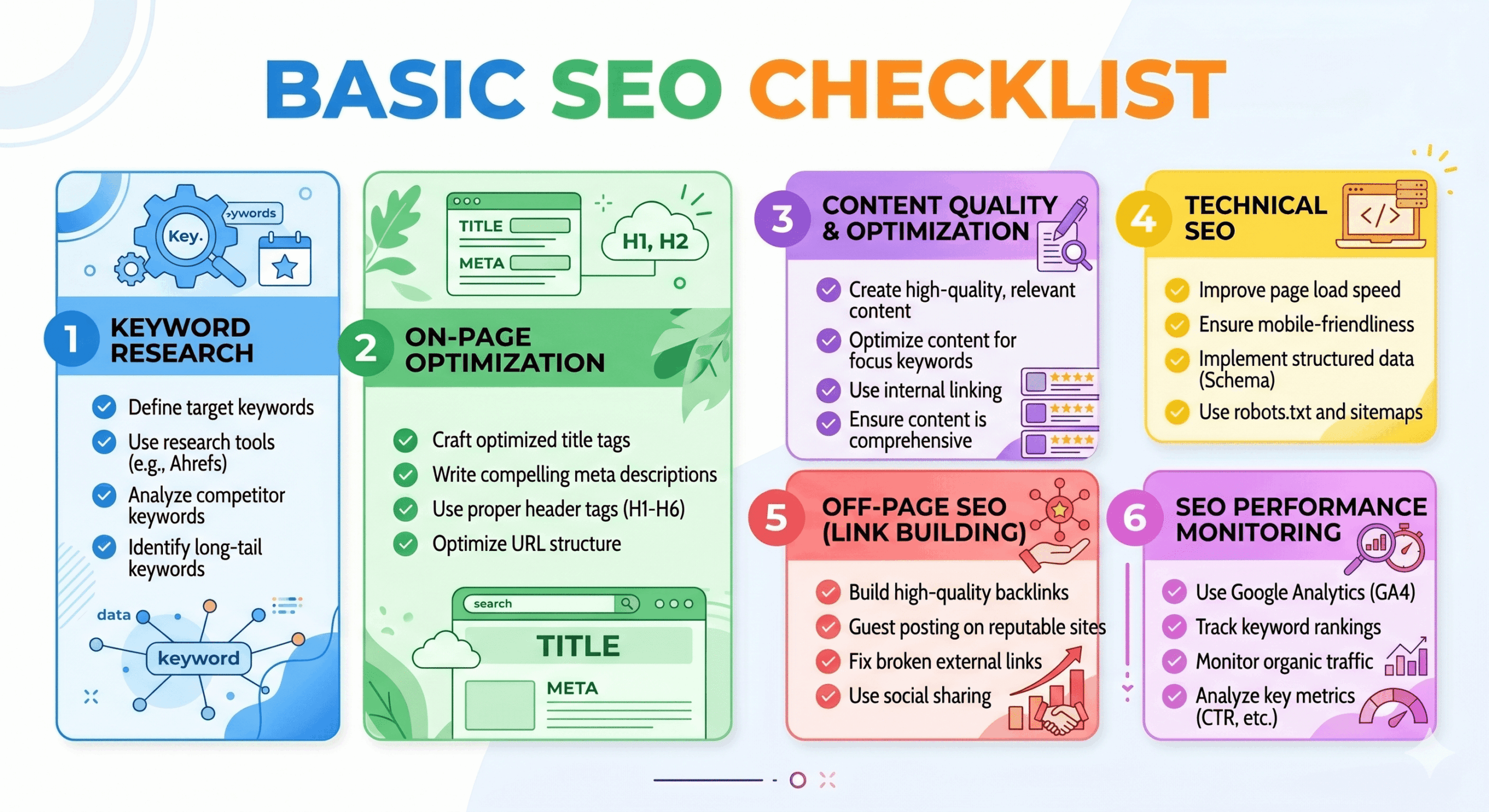
Basic SEO Checklist
Table of Contents
Search engine optimization often feels like a puzzle with shifting pieces. For many website owners, the sheer volume of technical jargon can be overwhelming. However, ranking on Google doesn’t always require a PhD in computer science. By following a structured basic seo checklist, you can clear the fog and start driving meaningful organic traffic to your site. This guide is designed for beginners, small business owners, and content creators who need a clear, actionable roadmap to improve their search visibility without getting lost in the weeds.
The goal of this checklist is to solve the problem of “analysis paralysis.” Instead of wondering what to do next, you will have a step-by-step framework to ensure your website meets the fundamental requirements that search engines look for. From setting up your tracking tools to optimizing individual pages, this guide covers the essentials that form the bedrock of any successful digital marketing strategy.
Preparation Stage
Before you write a single word of content, you need to set up the infrastructure that allows you to measure success. Without data, you are essentially flying blind. These initial steps ensure that search engines can actually see your site and that you can track how users are interacting with it.
- ✅ Set up Google Search Console: This is the most important tool for any webmaster. It allows you to see which keywords you rank for and identifies technical errors that might be holding you back.
- ✅ Install Google Analytics 4 (GA4): While Search Console tells you how people find you, GA4 tells you what they do once they arrive. Understanding user behavior is key to long-term growth.
- ✅ Create and submit an XML Sitemap: This acts as a map for search engine crawlers, helping them find all the important pages on your website quickly.
- ✅ Check your Robots.txt file: Ensure you aren’t accidentally “disallowing” search engines from crawling your most important sections.
- ✅ Verify your SSL Certificate: Security is a ranking factor. Make sure your site loads over HTTPS to protect user data and gain search engine trust.
Planning Your Basic SEO Checklist Strategy
Strategy is where most people fail. They create content based on gut feeling rather than data. During the planning stage, you identify the “low-hanging fruit”—the keywords that your target audience is actually searching for. Integrating a basic seo checklist into your workflow at this stage ensures that your efforts are aligned with real user intent.
- ✅ Conduct Keyword Research: Use tools like Google Keyword Planner or Ubersuggest to find terms with high search volume and manageable competition.
- ✅ Analyze Search Intent: Before targeting a keyword, look at the top results. Is Google showing blog posts, product pages, or videos? Your content must match what the user expects to find.
- ✅ Perform a Competitor Gap Analysis: Identify topics your competitors have covered that you haven’t. This helps you find opportunities to provide better, more comprehensive information.
- ✅ Organize a Content Calendar: Consistency is vital in SEO. Plan your topics in advance to ensure a steady stream of optimized content.
- ✅ Review this basic seo checklist regularly: Make sure your planning phase accounts for every technical and on-page requirement before you start building.
Creation Stage
Content is the heart of SEO. However, “good” content isn’t just about prose; it’s about structure and relevance. During the creation phase, your focus should be on providing the best possible answer to a user’s query while making it easy for search engines to understand the context of your page.
- ✅ Write a Compelling Hook: Your first paragraph should address the user’s problem immediately. Use your primary keyword early—ideally within the first 100 words.
- ✅ Use Proper Heading Hierarchy: Use one H1 tag for the title and use H2 and H3 tags to break up sections. This helps crawlers understand the structure of your information.
- ✅ Optimize for Readability: Use short sentences and paragraphs. Use bullet points and numbered lists to make the content “scannable” for mobile users.
- ✅ Include Multimedia: Original images, charts, and videos increase time-on-page, which is a positive signal to search engines.
- ✅ Internal Linking: Link to at least 2 or 3 other relevant pages on your site. This helps distribute “link equity” and keeps users engaged longer.
Publishing with a Basic SEO Checklist in Mind
The moment you hit “publish” is the culmination of your hard work, but there are a few technical checkboxes to tick before the page goes live. These small details often make the difference between page one and page ten of the search results.
- ✅ Optimize the URL Slug: Keep your URLs short and descriptive. Include the focus keyword and avoid using dates or random strings of numbers.
- ✅ Craft a Unique Meta Title: Your title tag is often the first thing a user sees in the search results. Keep it under 60 characters and make it enticing.
- ✅ Write a Meta Description: While not a direct ranking factor, a great description improves your Click-Through Rate (CTR). Summarize the value of the page in under 160 characters.
- ✅ Add Image Alt Text: Describe your images for screen readers and search engines. This also helps your images appear in Google Image Search.
- ✅ Check Mobile Responsiveness: Use Google’s mobile-friendly testing tools to ensure your page looks great and functions perfectly on smartphones.
Promotion and Follow-up Stage
SEO doesn’t end when the page is live. The “set it and forget it” mentality rarely works in competitive niches. You need to actively promote your content and monitor its performance to see where improvements can be made over time. This phase ensures your basic seo checklist leads to long-term sustainable growth.
- ✅ Share on Social Media: While social signals aren’t a direct ranking factor, they drive traffic and increase the chances of earning natural backlinks.
- ✅ Execute Basic Link Building: Reach out to industry partners or bloggers to see if your content can add value to their existing articles.
- ✅ Monitor Rankings: Check Google Search Console after a few weeks to see which queries are driving impressions.
- ✅ Update Content Annually: Search engines love fresh content. Revisit your top-performing pages once a year to update facts, links, and statistics.
- ✅ Fix Broken Links: Periodically use a tool like “Check My Links” to ensure that your internal and external links are still functional.
Pro Tips
Once you have mastered the fundamentals, these advanced tips can give you an edge over the competition. These are practical steps that move beyond the basics into high-performance optimization.
- ✅ Focus on Page Speed: Use Google PageSpeed Insights. A fast-loading site improves user experience and is favored by Google’s Core Web Vitals update.
- ✅ Leverage Featured Snippets: Structure your content to answer specific “Who, What, Where, Why” questions clearly to potentially earn the “Position Zero” spot.
- ✅ Use Schema Markup: Adding structured data helps search engines understand your content type, whether it’s a recipe, a review, or an FAQ.
- ✅ Monitor Your Bounce Rate: If users leave your site immediately, it suggests your content doesn’t match their intent. Re-evaluate your headings and intro.
Conclusion
Implementing a basic seo checklist is not a one-time event, but a continuous cycle of improvement. By focusing on the preparation, planning, and execution stages outlined above, you build a digital asset that grows in value every day. Remember, SEO is a marathon, not a sprint. The efforts you put into keyword