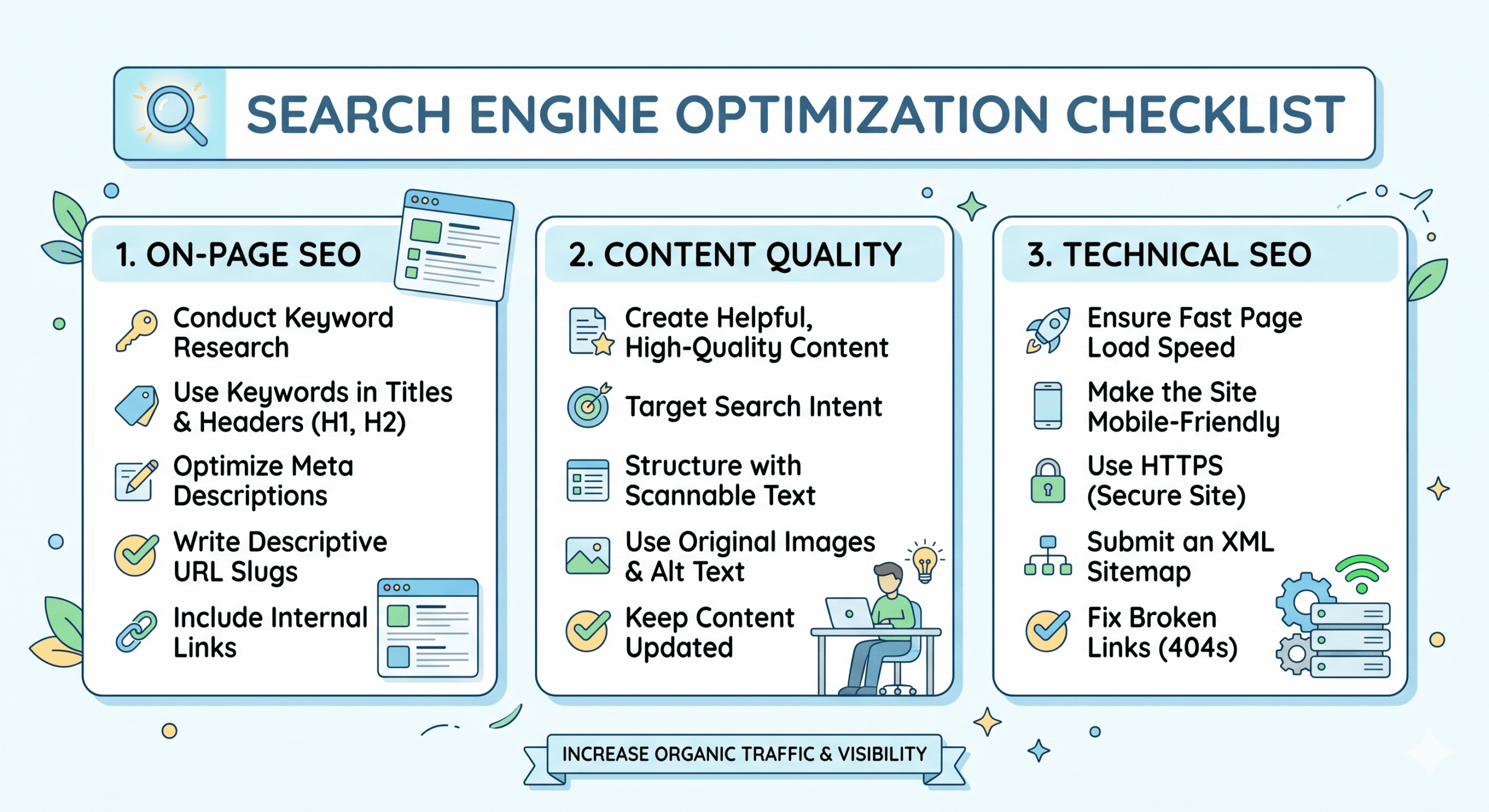
Search Engine Optimization Checklist
Navigating the complex world of digital marketing can feel like trying to find a needle in a haystack without a map. Whether you are a small business owner launching your first website or a seasoned marketer looking to refine your process, having a reliable search engine optimization checklist is essential for consistent success. This guide is designed to solve the problem of “SEO overwhelm” by breaking down the technical and creative aspects of ranking into manageable, actionable steps that ensure your content actually gets seen by your target audience.
Search engines like Google use hundreds of ranking factors to determine which pages deserve the top spot. Without a structured approach, it is easy to miss critical elements like meta descriptions, site speed optimizations, or keyword intent mapping. By following this systematic workflow, you can move from guesswork to a data-driven strategy that builds long-term organic authority and drives sustainable traffic to your site.
Preparation Stage
Before you write a single word of content, you need to ensure your foundation is solid. SEO is not just about keywords; it is about how search engines crawl and interpret your entire website infrastructure.
- ✅ Set up Google Search Console: This is the most important tool for monitoring your site’s health and seeing how Google views your pages.
- ✅ Install Google Analytics 4 (GA4): Track where your visitors come from and how they interact with your content to measure the success of your search engine optimization checklist.
- ✅ Check for Indexing Issues: Use the “Coverage” report in Search Console to ensure your important pages are not being blocked by robots.txt or “noindex” tags.
- ✅ Verify Mobile-Friendliness: Use Google’s mobile-friendly test to ensure your site looks and functions perfectly on smartphones.
- ✅ Audit Site Speed: Run a PageSpeed Insights report and aim for a score above 80 on both mobile and desktop to reduce bounce rates.
- ✅ Install an SEO Plugin: If you are using WordPress, tools like Yoast or RankMath can help automate basic technical tasks.
Planning Stage
A successful strategy starts with deep research. You need to understand what your audience is searching for and what your competitors are doing better than you. Use this phase to map out your roadmap before diving into the execution.
- ✅ Conduct Keyword Research: Identify high-volume, low-competition keywords using tools like SEMrush, Ahrefs, or AnswerThePublic.
- ✅ Analyze Search Intent: Look at the current top-ranking results for your target keyword. Is the intent informational, transactional, or navigational?
- ✅ Map Keywords to URLs: Assign one primary keyword to each page to avoid keyword cannibalization, where your own pages compete against each other.
- ✅ Perform a Competitor Gap Analysis: Identify topics your competitors have covered that you haven’t, and find ways to provide more value.
- ✅ Identify Long-Tail Opportunities: Target specific three-to-five-word phrases that are easier to rank for and often have higher conversion rates.
Creation Stage
This is where the magic happens. High-quality content is the cornerstone of any effective search engine optimization checklist. Your goal is to create content that is significantly better than what currently exists on the first page of search results.
- ✅ Write Compelling Title Tags: Include your focus keyword near the beginning and keep the length under 60 characters to avoid truncation.
- ✅ Draft Unique Meta Descriptions: Write a 150-160 character summary that “sells” the click to the user, including a clear call-to-action.
- ✅ Optimize Header Tags (H1-H3): Use a single H1 for your main title and use H2s and H3s to break up the content logically for readers and crawlers.
- ✅ Optimize Image Alt Text: Describe your images accurately for accessibility and include relevant keywords where they fit naturally.
- ✅ Check Keyword Density: Ensure your focus keyword appears in the first 100 words and naturally throughout the body, but avoid keyword stuffing at all costs.
- ✅ Include Multimedia: Use original photos, infographics, or videos to increase time-on-page, which is a positive ranking signal.
Publishing or Execution Stage
Once your content is created, the way you present it to the world matters. Technical execution ensures that the quality of your writing is matched by the quality of your page’s performance and structure.
- ✅ Create an SEO-Friendly URL: Keep URLs short, descriptive, and use hyphens to separate words (e.g., /search-engine-optimization-checklist/).
- ✅ Implement Internal Linking: Link to at least 2-3 other relevant pages on your own site to distribute “link equity” and help users find more value.
- ✅ Add Schema Markup: Use structured data (FAQ, Review, or Article schema) to help search engines understand your content and earn rich snippets.
- ✅ Fix Broken Links: Before hitting publish, use a link checker to ensure every external and internal link works perfectly.
- ✅ Optimize for Readability: Use short paragraphs, bullet points, and bold text to make the content easy to scan for mobile users.
Promotion and Follow-up Stage
Publishing the content is only half the battle. To truly succeed with your search engine optimization checklist, you must actively promote your work and monitor its performance over time to make necessary adjustments.
- ✅ Build Initial Backlinks: Reach out to industry partners or bloggers to see if your new resource is something they would find valuable to link to.
- ✅ Share on Social Media: Distribute your content across LinkedIn, Twitter, and Facebook to drive immediate social signals and traffic.
- ✅ Monitor Rankings: Use a rank tracker to see how your target keywords move in the SERPs (Search Engine Results Pages) over the first 30 days.
- ✅ Refresh Underperforming Content: If a page isn’t ranking after a few months, revisit the keyword intent and update the information to be more current.
- ✅ Check Core Web Vitals: Periodically review your site’s performance metrics in Search Console to ensure your user experience remains top-tier.
Pro Tips
Take your results to the next level with these advanced strategies that many of your competitors might be overlooking.
- Target the “People Also Ask” Section: Structure some of your H3s as direct questions and provide concise, 40-50 word answers to win featured snippets.
- Focus on Topic Clusters: Instead of individual keywords, build “pillar pages” that link to several related “cluster” articles to establish niche authority.
- Optimize for Voice Search: Use conversational language and natural phrasing, as more users are searching via Siri, Alexa, and Google Assistant.
- Analyze User Behavior: Use heatmaps to see where users drop off. If they aren’t reaching the bottom of the page, your introduction might need more “hook.”
- Prune Low-Value Pages: Sometimes, deleting or merging thin, outdated content can actually boost the overall SEO health of your entire domain.
Conclusion
Implementing a comprehensive search engine optimization checklist is the most effective way to ensure your digital presence is both visible and authoritative. SEO is not a “set it and forget it” task; it is a continuous cycle of preparation, planning, creation, and refinement. By checking off these items systematically, you remove the guesswork and build a website that serves both search engine algorithms and, more importantly, your human visitors.
Don’t let your hard work go unnoticed in the depths of page ten. Start at the beginning of this list today and audit your most important pages. Consistency is the key to organic growth. Are you ready to see your rankings climb? Download or bookmark this guide and start optimizing your path to the top of the search results now!