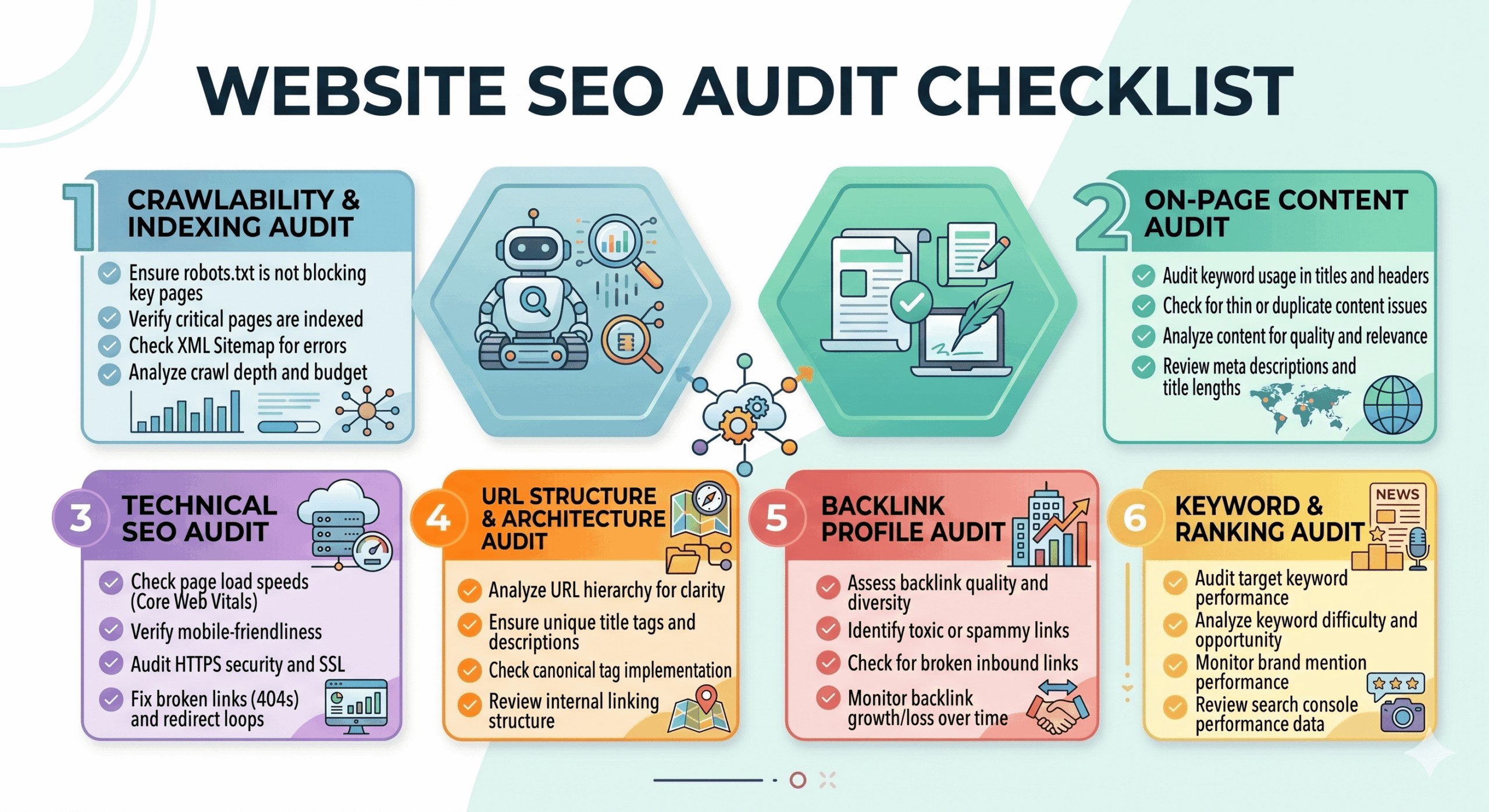
Website SEO Audit Checklist
Table of Contents
Is your website underperforming despite your best efforts to create quality content? Many site owners feel like they are shouting into a void because search engines simply aren’t seeing them. To fix this, you need a comprehensive website seo audit checklist to identify technical bottlenecks, content gaps, and ranking opportunities. This guide is designed for digital marketers, small business owners, and web developers who want a clear, actionable roadmap to improve their search engine visibility. By the end of this process, you will have a prioritized list of improvements that can lead to higher rankings, more organic traffic, and a better user experience.
Preparation Stage: Setting the Foundation for Your Website SEO Audit Checklist
Before you dive into the technical details, you need to gather the right data. An audit is only as good as the information you provide it. In this stage, you are setting up the diagnostic tools required to “see” your website the way Google does.
- ✅ Connect and verify your site with Google Search Console to monitor indexing and performance.
- ✅ Set up Google Analytics 4 (GA4) to track user behavior and conversion metrics.
- ✅ Select a high-quality crawling tool, such as Screaming Frog, Ahrefs, or Semrush, to scan for broken links.
- ✅ Ensure you have administrative access to your CMS (WordPress, Shopify, etc.) to implement changes.
- ✅ Document your current organic traffic levels to create a baseline for future comparison.
- ✅ Define the primary goal of your website seo audit checklist, whether it is fixing technical errors or improving content relevance.
Planning Stage: Strategy and Competitor Analysis
Diving into an audit without a plan often leads to “analysis paralysis.” You need to know what you are looking for and who you are competing against. This stage focuses on the strategic alignment of your SEO efforts.
- ✅ Identify your top 3-5 organic competitors and analyze which keywords they are currently ranking for.
- ✅ Perform a keyword gap analysis to find topics your competitors cover that you might have missed.
- ✅ Categorize your website pages into clusters (e.g., product pages, blog posts, service pages) to audit them in batches.
- ✅ Create a spreadsheet to log every issue found during the audit, categorized by “Priority” and “Difficulty.”
- ✅ Check for any historical manual penalties or significant traffic drops that coincide with Google algorithm updates.
Creation Stage: Executing the Website SEO Audit Checklist Tasks
This is the core of the audit. Here, you will scrutinize the technical health and on-page elements of your site. This stage involves identifying the “leaks” in your SEO bucket and preparing the fixes.
- ✅ Run a full site crawl to identify 404 errors, 5xx server errors, and unnecessary 301 redirects.
- ✅ Audit your XML sitemap to ensure it is clean, updated, and submitted to search engines.
- ✅ Check your robots.txt file to ensure important pages are not being accidentally blocked from crawlers.
- ✅ Evaluate page load speeds using Google PageSpeed Insights, focusing on Core Web Vitals like LCP and CLS.
- ✅ Inspect mobile responsiveness to ensure the site is fully functional and readable on all device sizes.
- ✅ Review all Title Tags and Meta Descriptions for duplicates, missing entries, or over-optimization.
- ✅ Verify that every page has a single H1 tag that includes the primary target keyword naturally.
- ✅ Analyze your internal linking structure to ensure “link juice” is flowing to your most important pages.
- ✅ Scan for duplicate content issues using tools like Copyscape or Siteliner to avoid “cannibalization.”
Publishing or Execution Stage: Implementing the Fixes
Once the problems are identified, it is time to take action. This stage is about cleaning up the code, updating the content, and ensuring your site is perfectly optimized for both users and search bots.
- ✅ Update broken internal links to point to live, relevant URLs instead of 404 pages.
- ✅ Optimize large image files by compressing them and adding descriptive Alt Text for accessibility.
- ✅ Rewrite thin or low-quality content to provide more value and meet the “Helpful Content” standards.
- ✅ Fix “Redirect Chains” where one URL redirects to another, which then redirects to a third.
- ✅ Implement Schema Markup (Structured Data) to help search engines understand your content better.
- ✅ Consolidate duplicate pages using 301 redirects or canonical tags to signal the preferred version to Google.
- ✅ Ensure your URL structure is “pretty”—meaning it is short, descriptive, and uses hyphens rather than underscores.
Promotion and Follow-up Stage: Maintenance and Growth
SEO is not a one-time event; it is a continuous cycle. After you have implemented the technical and on-page fixes, you must monitor the results and continue building the site’s authority through external signals.
- ✅ Monitor the “Indexing” report in Google Search Console to confirm that your fixed pages are being crawled.
- ✅ Conduct a backlink audit to identify and disavow toxic or spammy links that could harm your reputation.
- ✅ Reach out to industry partners or bloggers for guest posting opportunities to build high-quality backlinks.
- ✅ Re-share updated content on social media channels to drive immediate traffic and signal freshness.
- ✅ Set a recurring schedule (e.g., quarterly) to run your website seo audit checklist again to catch new issues.
- ✅ Track keyword ranking movements using a tool like Wincher or Nightwatch to see the impact of your changes.
Pro Tips for Advanced SEO Auditing
To truly stand out in a competitive niche, you need to go beyond the basics. Here are some advanced tips to elevate your SEO strategy:
- Analyze Search Intent: Don’t just look at keywords. Ensure the content on your page matches the *intent* of the searcher (e.g., Informational, Transactional, or Navigational).
- Optimize for Featured Snippets: Structure your content with clear headings and concise answers to common questions to win the “Position Zero” spot on Google.
- Check for E-E-A-T: Ensure your “About” and “Contact” pages are robust. Show search engines that you have Experience, Expertise, Authoritativeness, and Trustworthiness.
- Monitor Log Files: For larger sites, analyzing server logs can show exactly how often Googlebot visits specific pages, helping you optimize your “crawl budget.”
- User Experience (UX) Audit: Use heatmaps like Hotjar to see where users get stuck. A site that is easy to navigate will naturally rank better over time.
Conclusion
Performing a thorough audit is the most effective way to turn a stagnant website into a high-performing lead-generation machine. By following this website seo audit checklist, you have addressed the technical foundation, refined your on-page strategy, and set a path for long-term growth. Remember that SEO is a marathon, not a sprint; the changes you make today may take weeks to fully reflect in the search results, but the results are cumulative and long-lasting.
Don’t let your competitors outshine you in the search results. Start your audit today by picking one section of this checklist and working through it systematically. If you found this guide helpful, share it with your team and start building a more visible, authoritative web presence right now!