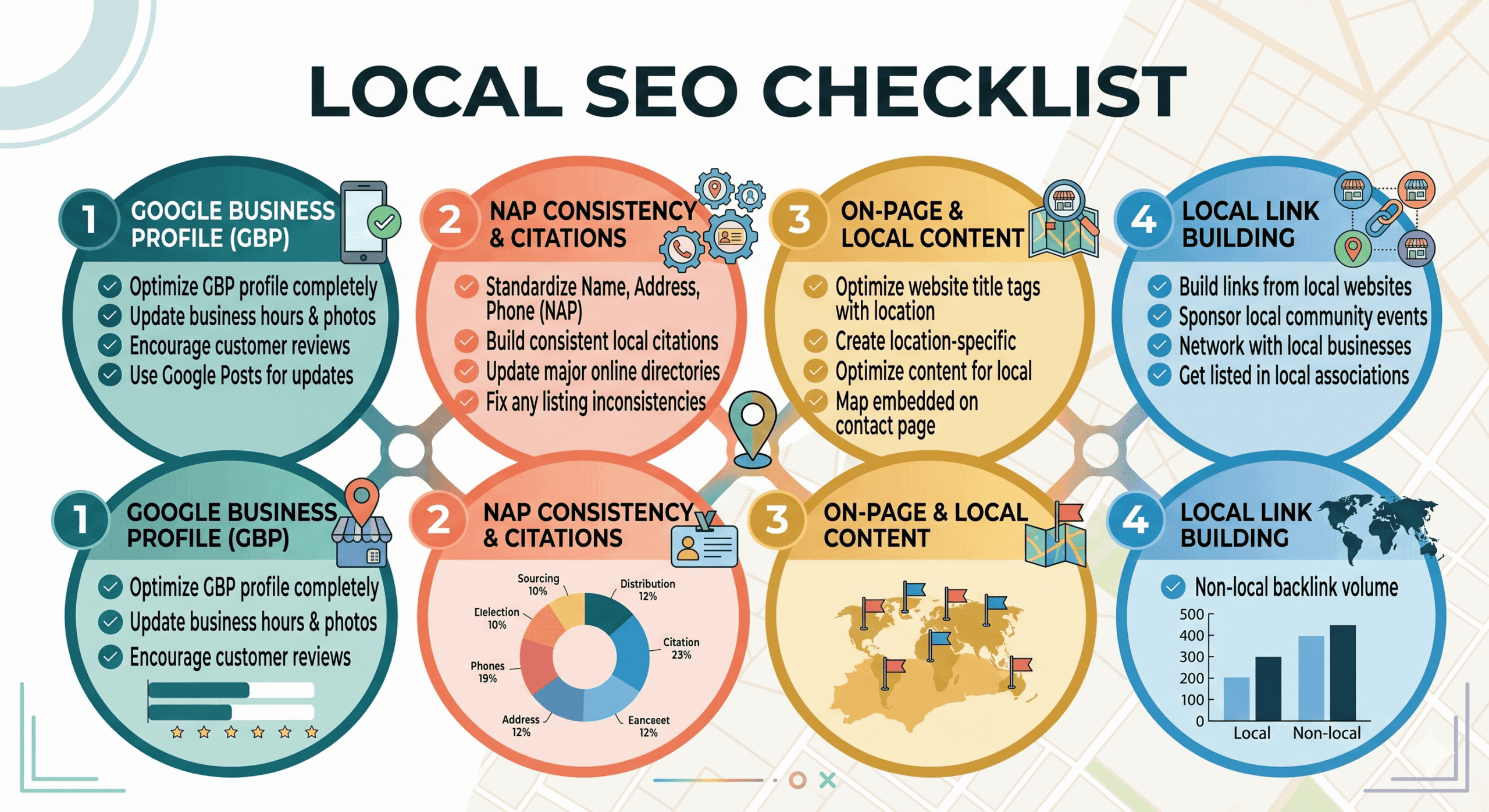
Local SEO Checklist
Table of Contents
Navigating the world of search engines can often feel like a complex maze, but a comprehensive local seo checklist is the ultimate map for any business owner looking to dominate their neighborhood. Whether you are a boutique cafe, a regional law firm, or a multi-location service provider, appearing in the “Local Pack” is the difference between a ringing phone and digital silence. This guide is designed for marketing managers and small business owners who need a practical, step-by-step framework to improve their visibility in local search results and drive more foot traffic to their physical locations.
Preparation Stage
Before you start optimizing your website, you must gather the essential building blocks of your local identity. Consistency is the foundation of local search success, and any discrepancies at this stage can confuse search engine algorithms later on.
- ✅ Audit your NAP data: Ensure your Name, Address, and Phone number are identical across all internal documents.
- ✅ Claim your Google Business Profile (GBP): If you haven’t claimed your listing, this is your absolute first priority.
- ✅ Verify your Bing Places for Business: While Google is king, Bing still captures a significant portion of local desktop searches.
- ✅ Set up Apple Business Connect: Ensure iPhone users see accurate information when searching via Apple Maps.
- ✅ Gather high-resolution photos: Collect images of your storefront, team, and products to use across various directories.
Planning Your Local SEO Checklist
Success in local search is rarely accidental; it requires a strategic approach to understanding how your neighbors are searching for your services. A well-researched plan ensures you aren’t wasting effort on broad terms that don’t convert locally.
- ✅ Perform local keyword research: Use tools to find “service + city” keywords (e.g., “plumber in Austin”) and “near me” variations.
- ✅ Analyze the Local Pack: Look at the top three businesses currently ranking for your target terms and note their category choices.
- ✅ Map out location-specific landing pages: If you have multiple offices, plan a unique URL and unique content for each one.
- ✅ Audit your competitors’ citations: Identify where your successful competitors are listed and add those sites to your target list.
- ✅ Define your primary GBP category: Choosing the right primary category is one of the strongest ranking factors in local search.
Creation Stage
The creation phase is where you build the assets that search engines will crawl. At this point, your local seo checklist moves from theory into tangible digital content that speaks directly to your local community.
- ✅ Write unique local landing page copy: Avoid “cookie-cutter” content for different locations; mention local landmarks, neighborhoods, and community involvement.
- ✅ Optimize meta tags: Include your city and core service in the Title Tag and Meta Description of your homepage.
- ✅ Embed a Google Map: Place a live Google Map on your contact page to help Google verify your physical location.
- ✅ Implement LocalBusiness Schema: Add structured data markup to your site’s code so search engines can easily read your operating hours and address.
- ✅ Create a “Google Business Profile” posting schedule: Plan weekly updates to share news, offers, and events directly on your search listing.
Executing Your Local SEO Checklist
Execution is about taking your planned assets and making them live while ensuring all technical elements are firing correctly. This stage bridges the gap between having a website and having a local search presence that actually converts visitors into customers.
- ✅ Complete every field in your Google Business Profile: Don’t leave any section blank, including the “attributes” and “services” sections.
- ✅ Submit to major aggregators: Ensure your data is pushed to Data Axle, Neustar Localeze, and Foursquare.
- ✅ Standardize your footer: Make sure your NAP information is present in the footer of every page on your website in a crawlable format.
- ✅ Optimize images for local: Use your local seo checklist to remind you to include geographic keywords in the image Alt-text and filenames.
- ✅ Clean up duplicate listings: Search for and merge any duplicate Google Business Profiles to prevent ranking cannibalization.
Promotion and Follow-up Stage
Local SEO is not a “set it and forget it” task. To maintain your rankings against aggressive competitors, you must engage in ongoing promotion and reputation management. This ensures your business remains relevant and trustworthy in the eyes of both users and algorithms.
- ✅ Launch a review acquisition campaign: Reach out to past customers via email or SMS to request honest reviews on Google.
- ✅ Respond to all reviews: Reply to both positive and negative feedback to show Google you are an active and engaged business.
- ✅ Build local backlinks: Sponsor a local little league team or contribute a guest post to a neighborhood blog to earn hyper-local links.
- ✅ Monitor your local rankings: Use a grid-tracking tool to see how your rankings change based on the user’s physical distance from your shop.
- ✅ Update holiday hours: Regularly update your GBP during holidays to avoid frustrating customers who might show up to a closed store.
Pro Tips
To truly stay ahead of the curve, consider these advanced strategies that many of your competitors are likely ignoring. These tips focus on user experience and emerging search trends.
- Focus on Mobile Speed: Most local searches happen on the go. If your mobile site takes more than 3 seconds to load, you are losing local leads.
- Voice Search Optimization: People use voice assistants like Siri and Alexa for local queries. Use natural, conversational language in your FAQs.
- Utilize GBP Q&A: Pre-populate your own Google Business Profile Q&A section with common questions to provide immediate value to searchers.
- Track Phone Calls: Use a dedicated tracking number (via local call tracking software) to see exactly how many leads are coming from your local efforts.
- Geo-tagging Photos: While Google strips EXIF data, uploading photos taken at your physical location helps build a footprint of authenticity.
Conclusion
Mastering local search is about more than just appearing on a map; it is about building trust with your community and making it as easy as possible for customers to find you. By following this local seo checklist, you have built a solid foundation that covers technical optimization, content creation, and reputation management. The secret to long-term success is consistency. Keep your information updated, keep those reviews coming in, and continue providing value to your local audience. Now is the time to take action. Start with your Google Business Profile today and watch your local visibility grow!