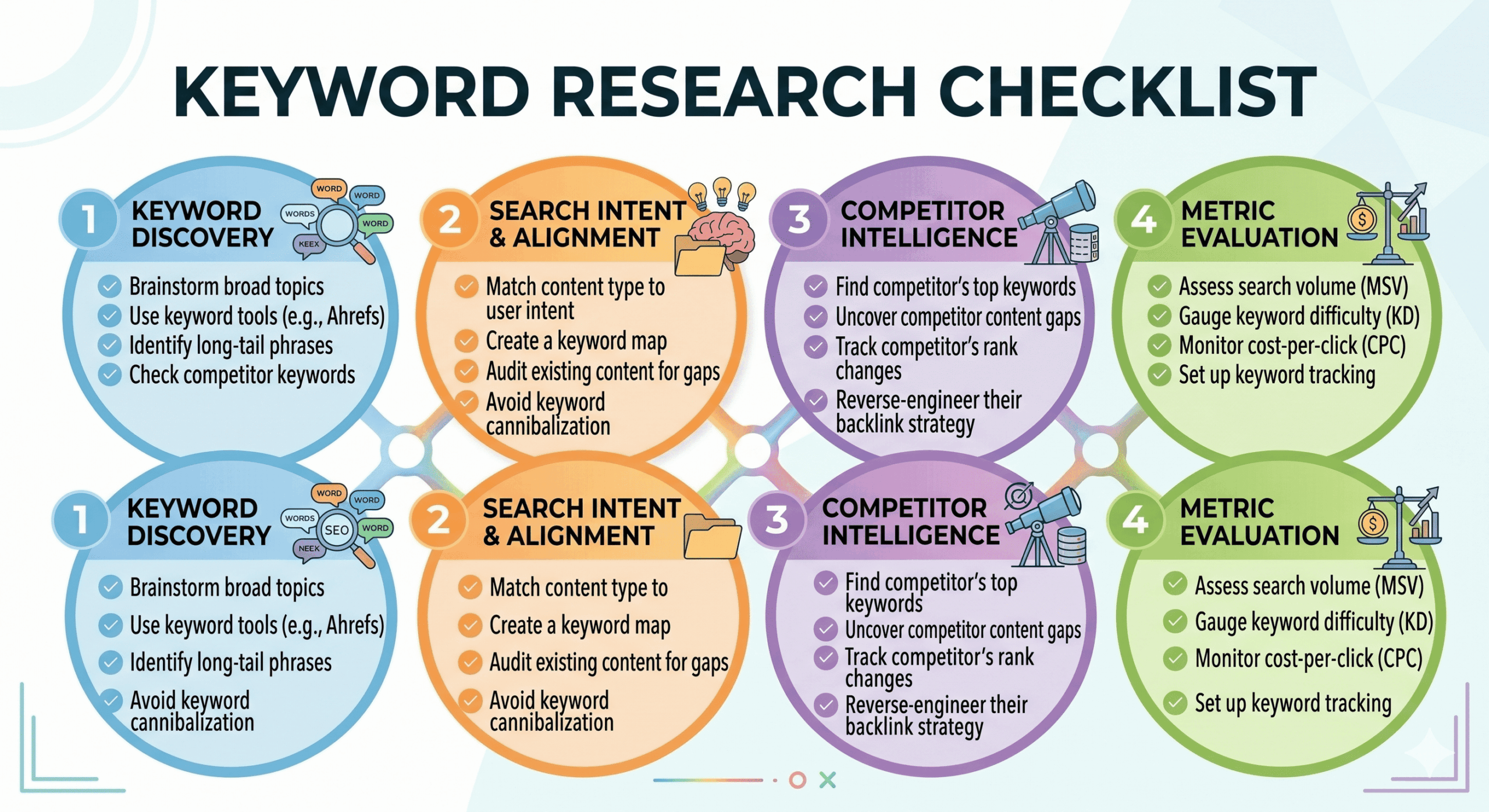
Keyword Research Checklist
Table of Contents
Mastering the art of search engine optimization often feels like trying to hit a moving target. However, the most successful digital marketers know that success isn’t about luck; it is about having a repeatable, data-driven process. Whether you are a seasoned SEO professional, a small business owner, or a content creator, using a comprehensive keyword research checklist is the only way to ensure you are not wasting time on content that no one is searching for. This guide solves the common problem of “keyword paralysis”—that overwhelming feeling of having too much data and no clear direction—by providing a structured path from initial brainstorming to final execution.
The Foundation: Preparation Stage for Your Keyword Research Checklist
Before you dive into expensive tools or complex spreadsheets, you need to establish the “why” behind your search. Skipping this stage usually leads to targeting terms that bring in traffic but zero conversions. Use these steps to align your strategy with your business goals.
- ✅ Define your primary business goals (e.g., brand awareness, lead generation, or direct sales).
- ✅ Identify your ideal customer persona and their specific pain points.
- ✅ Brainstorm 5-10 “seed keywords” that broadly describe your products or services.
- ✅ Analyze your current website performance to see which terms are already driving traffic.
- ✅ Document your main competitors to understand whose market share you are targeting.
Planning Stage: Tools and Competitor Intel
Once you have your seed keywords, it is time to expand your horizons. The planning stage is about gathering raw data and understanding the landscape of your niche. You want to see what your competitors are doing right and where they are failing so you can fill those gaps. This is a critical part of your keyword research checklist because it helps you identify low-hanging fruit.
- ✅ Select your primary research tools (Google Keyword Planner, Ahrefs, Semrush, or Ubersuggest).
- ✅ Perform a “keyword gap analysis” to see which terms your competitors rank for that you do not.
- ✅ Identify the search intent for your seed keywords: are users looking to buy (transactional) or to learn (informational)?
- ✅ Use Google’s “People Also Ask” and “Related Searches” to find natural language queries.
- ✅ Look for seasonal trends using Google Trends to ensure your timing is right.
Creation Stage: Refining Your Keyword Research Checklist
Data is useless if it isn’t organized. In this stage, you will filter your massive list of potential terms into a lean, mean, ranking machine. You need to balance search volume with keyword difficulty to find terms you can actually rank for within a reasonable timeframe. This refinement is what separates amateur SEO from expert execution.
- ✅ Filter your list by search volume to ensure there is enough demand to justify the effort.
- ✅ Evaluate Keyword Difficulty (KD) scores and prioritize terms that match your site’s authority.
- ✅ Group related keywords into “topic clusters” to help build topical authority.
- ✅ Select one “primary keyword” and 3-5 “secondary/LSI keywords” for every piece of content.
- ✅ ✅ Finalize the core list based on the parameters of your keyword research checklist to ensure no high-value terms are missed.
Publishing or Execution Stage: Content Integration
Now that you have your golden list, it is time to put it to work. Keyword research does not end with a spreadsheet; it continues through the content creation process. Proper placement ensures that search engine crawlers understand exactly what your page is about without triggering “keyword stuffing” penalties.
- ✅ Include your primary keyword in the H1 tag and the first 100 words of the content.
- ✅ Optimize the Title Tag and Meta Description to include your main keyword for better CTR.
- ✅ Sprinkle secondary keywords naturally into H2 and H3 subheadings.
- ✅ Ensure your URL slug is short, descriptive, and contains your focus keyword.
- ✅ Optimize image Alt Text using descriptive, keyword-rich language where appropriate.
Promotion and Follow-up Stage: Maintenance and Growth
SEO is never a “set it and forget it” task. To maintain your rankings, you must track your performance and adapt. This final stage of the keyword research checklist ensures your content remains relevant and continues to climb the SERPs (Search Engine Results Pages) long after the publish date.
- ✅ Set up rank tracking for your primary keywords to monitor fluctuations.
- ✅ Monitor Google Search Console to see which “surprise” keywords you are starting to rank for.
- ✅ Create internal links from older, high-authority posts to your new content.
- ✅ Update your content every 6-12 months to keep it fresh and maintain its ranking.
- ✅ Analyze user behavior (Bounce Rate/Time on Page) to ensure your keywords truly match user intent.
Pro Tips for Advanced SEO
To truly dominate the search results, you need to go beyond the basics. Here are some expert-level strategies to add to your workflow:
- Target Zero-Volume Keywords: Sometimes tools say a keyword has zero volume, but if it is highly specific to a buyer’s problem, it can result in high-quality conversions.
- Analyze the SERP Features: If a keyword’s results page is filled with videos, you should create a video. If it’s all “Best of” lists, your content should be a listicle.
- Focus on Topic Clusters: Instead of targeting one-off keywords, build a web of content around a “pillar page” to signal to Google that you are an expert in the entire subject.
- The “Double-Down” Strategy: If you find you are ranking on page two for a high-value term, add more depth, images, and internal links to push it onto page one.
Conclusion
Success in search engines is rarely an accident. By following a structured keyword research checklist, you remove the guesswork and replace it with a strategy that consistently brings in the right kind of traffic. Remember that SEO is a marathon, not a sprint. The goal is to build a sustainable pipeline of visitors who are genuinely interested in what you have to say or sell. Don’t let your content get lost in the noise of the internet. Start using this checklist today, audit your existing pages, and begin building a digital presence that search engines—and users—will love. Ready to see your rankings climb? Open up your spreadsheet and start your first keyword audit now!