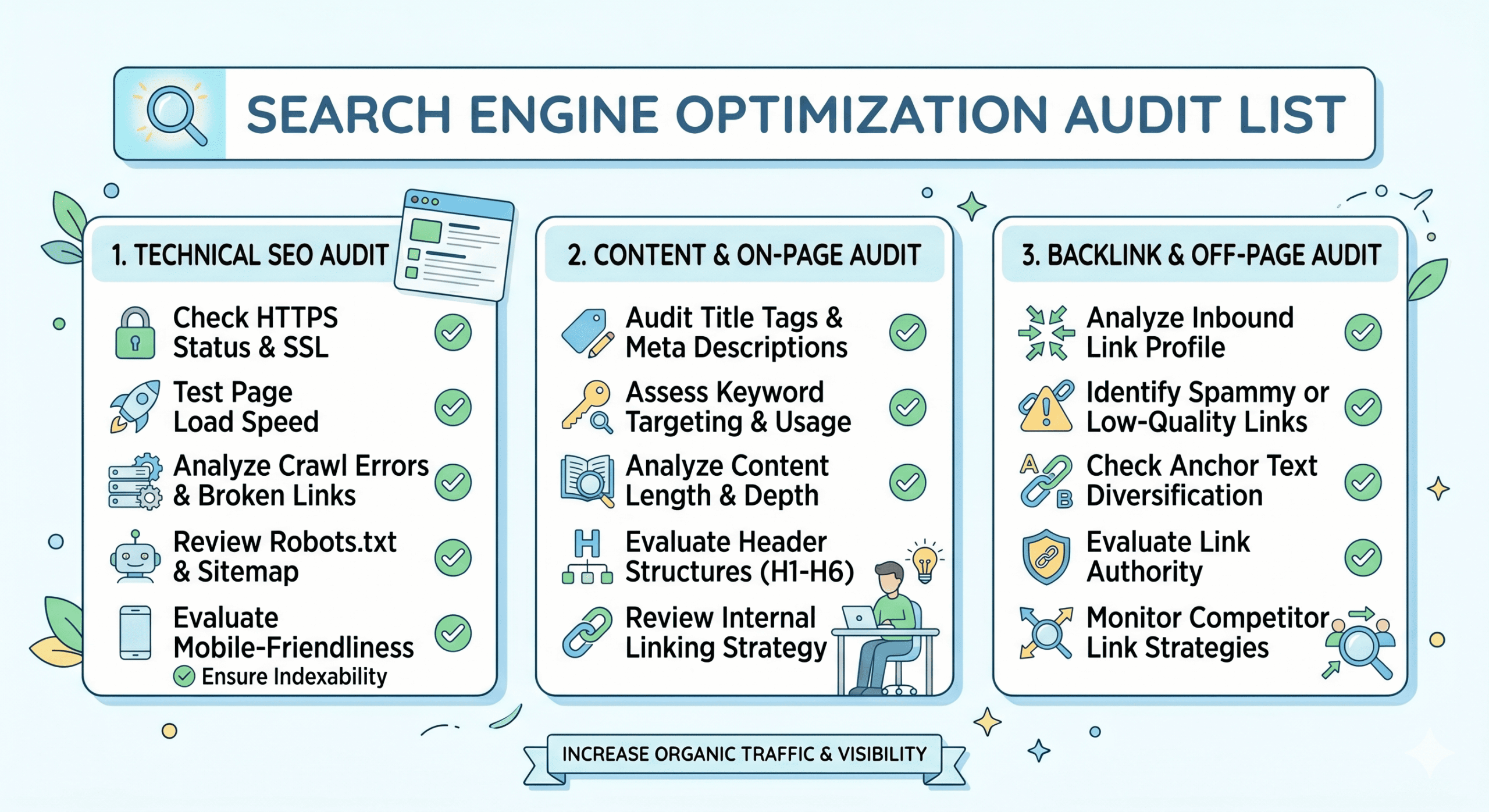
SEO Audit List
Table of Contents
Managing a website without a regular health check is like driving a car without ever looking under the hood. To ensure your digital presence remains competitive, you need a comprehensive seo audit list that identifies technical glitches, content gaps, and ranking opportunities. Whether you are a business owner trying to increase organic traffic or a digital marketer looking for a structured workflow, this guide provides a step-by-step roadmap to auditing your site like a pro. By following this checklist, you can stop guessing why your rankings are stagnant and start making data-driven improvements that search engines love.
The Ultimate SEO Audit List: Preparation Stage
Before diving into the data, you must gather the right tools and access. An audit is only as good as the information you collect, so setting the foundation is critical for success.
- ✅ Confirm access to Google Search Console (GSC) and verify that all site versions (HTTP/HTTPS, WWW/non-WWW) are tracked.
- ✅ Ensure Google Analytics 4 (GA4) is correctly installed and firing events to track user behavior and conversions.
- ✅ Select a reliable crawling tool such as Screaming Frog, Ahrefs, or Semrush to scan your site for technical errors.
- ✅ Connect your domain to a keyword tracking tool to establish a baseline for your current rankings.
- ✅ Create a dedicated spreadsheet or project management board to document every finding from your seo audit list.
Planning Stage: Tailoring Your SEO Audit List
Not every website has the same goals. A small local business needs a different approach than a massive e-commerce store. Use this stage to define your scope and identify what matters most for your specific niche.
- ✅ Define your primary KPIs (Key Performance Indicators) such as organic sessions, bounce rate, or lead conversions.
- ✅ Identify your top 5-10 direct competitors to benchmark their backlink profiles and content strategies.
- ✅ Determine the depth of the audit—will it be a quick technical check or a deep-dive content and authority analysis?
- ✅ Map out your site architecture to see if your most important pages are reachable within three clicks from the homepage.
- ✅ Review previous audit reports to check if past issues were actually resolved or if they have reappeared.
Creation and Execution Stage
This is the “meat” of the process. During this stage, you will actively crawl the site and analyze the on-page and off-page elements that influence your search engine visibility. Using an organized seo audit list ensures no stone is left unturned.
- ✅ Check for crawlability issues by reviewing your Robots.txt file and ensuring it isn’t accidentally blocking important pages.
- ✅ Validate your XML sitemap and ensure it is submitted to Google Search Console without errors.
- ✅ Identify and fix “404 Not Found” errors and eliminate internal redirect chains (301 loops).
- ✅ Optimize metadata by finding missing, duplicate, or overly long title tags and meta descriptions.
- ✅ Audit your header tags (H1, H2, H3) to ensure they follow a logical hierarchy and contain relevant keywords.
- ✅ ✅ Use your seo audit list to verify image alt text is present and descriptive for accessibility and image search rankings.
- ✅ Analyze page load speed using Google PageSpeed Insights, focusing on Core Web Vitals like LCP and CLS.
- ✅ Review content for “thin” or “duplicate” pages that might be cannibalizing your rankings or providing low value.
Publishing or Execution Stage
Once you have identified the issues, it is time to move from analysis to action. This stage focuses on implementing the fixes and prioritizing the tasks that will yield the highest return on investment.
- ✅ Categorize all identified issues into “High,” “Medium,” and “Low” priority based on their potential impact on rankings.
- ✅ Update your website’s internal linking structure to pass “link juice” to high-priority, underperforming pages.
- ✅ Correct all technical schema markup errors to help search engines better understand your content types.
- ✅ Refresh outdated content with new data, images, and current information to signal relevance to search engines.
- ✅ Ensure mobile-friendliness by testing your most important landing pages on multiple mobile devices and screen sizes.
Promotion and Follow-up Stage
The audit doesn’t end when the fixes are live. SEO is an ongoing process of monitoring, refining, and promoting your improved content to ensure long-term growth.
- ✅ Manually request indexing in Google Search Console for the pages where you have made significant changes.
- ✅ Monitor your “Crawl Stats” in GSC to see if search bots are visiting your site more frequently after the fixes.
- ✅ Launch a link-building campaign to acquire high-quality backlinks to the pages you just optimized.
- ✅ Share your updated, high-value content across social media platforms to drive initial traffic and signals.
- ✅ Schedule a follow-up review in 30 days to compare your new data against the baseline established at the start.
Pro Tips
For those looking to go beyond the basics, these advanced strategies will help you get the most out of your seo audit list and stay ahead of the competition.
- Look for Keyword Cannibalization: Use GSC to see if multiple pages are ranking for the same keyword. If they are, merge the content or use canonical tags to tell Google which version is the “master” page.
- Analyze the ‘Search Intent’: It is not enough to rank; you must satisfy the user. Check if your page content actually matches what users are looking for when they type a specific query.
- Audit Your “E-E-A-T”: Ensure your site demonstrates Experience, Expertise, Authoritativeness, and Trustworthiness by adding author bios, citing sources, and displaying clear contact information.
- Check Hidden Content: Ensure that content hidden behind tabs or accordions is still being indexed and read by search engine crawlers.
- Monitor Your Competitors’ Changes: Use tools to track when competitors update their pages, giving you insights into what is working in your industry right now.
Conclusion
Completing a thorough seo audit list is the single most effective way to gain clarity on your website’s performance. By systematically addressing technical debt, optimizing on-page elements, and monitoring your progress, you turn your website into a high-performing asset rather than just a digital placeholder. Remember, SEO is not a one-time event but a cycle of continuous improvement.
Take the first step today by auditing your homepage and fixing any broken links. Start implementing this checklist now to reclaim your rankings and drive the organic traffic your business deserves!